
Sage is one of the UK's largest software companies and a FTSE 100 business headquartered in Newcastle upon Tyne. The product portfolio has grown beyond the accounting software many people associate with the brand, and in 2026 it spans sole trader tools, small business accounting, payroll, HR, mid-market business management, cloud financial management, full ERP, and a growing layer of AI across the stack. This guide maps the whole Sage product ecosystem for UK readers so you can understand where each product fits and which one is right for your stage of business.
The Sage ecosystem can be confusing because several products have similar-sounding names, overlap in parts of the stack, and have evolved over the last decade through acquisitions and rebrands. This article breaks the portfolio down by audience size, shows how products connect to each other, summarises pricing where Sage publishes it, and flags the UK compliance features (MTD, FRS 102, PAYE RTI, auto-enrolment) that each product supports.
Use this as a reference. If you are evaluating Sage for a specific need, start at the tier that matches your business size and read across to the related products that naturally pair with it.
Vendor
Sage Group plc (FTSE 100), headquartered in Newcastle upon Tyne. UK heritage with a global customer base of around 200,000+ growing and mid-sized businesses.
Coverage
Sole traders, freelancers, small businesses, mid-market businesses, larger enterprises, accountants and bookkeepers, and HR/People teams. UK-localised across every tier.
AI layer
Sage Copilot is available across the portfolio, with specialist finance agents in Sage Intacct (AP Automation, Close, Assurance, Time, Finance Intelligence).
Compliance
Making Tax Digital for VAT and Income Tax, UK GAAP (FRS 102), UK payroll (PAYE RTI, auto-enrolment), and CIS for construction — covered across relevant Sage products.
Headline strength
Depth across the whole journey. Few vendors give UK businesses a clear path from sole trader to mid-market group without having to change provider.
How to read the Sage portfolio
Sage organises its UK offering along two axes. The first axis is business size: sole traders and small businesses, small-to-medium businesses, medium businesses, and enterprise. The second axis is function: accounting and finance, payroll, HR, and ERP/business management. Most products sit at the intersection of a size tier and a function.
The sections below walk through the portfolio in order of business size, so you can find your starting point, see what pairs with it, and understand the logical next product as the business grows.
Sage Sole Trader
Sage Sole Trader is the lightest product in the UK portfolio. It is aimed at self-employed people, freelancers, side-hustlers, and small landlords who need a simple way to track income, record expenses, connect a bank account, and prepare figures for Self Assessment.
The product is designed to be easy enough to use without an accountant, which is the point. It is not a full double-entry accounting system and it is not intended for VAT registration or payroll. For an ambitious sole trader likely to register for VAT, hire staff, or incorporate, Sage Accounting is usually the better starting point.
Best suited to non-VAT sole traders and landlords with simple finances.
Monthly subscription model with UK pricing on sage.com.
Supports Making Tax Digital workflows as HMRC rolls out MTD for Income Tax.
Natural upgrade path into Sage Accounting as the business grows.
Sage Accounting
Sage Accounting is the main cloud accounting product for UK sole traders, small limited companies, and growing small businesses. It is sold in three tiers — Start, Standard, and Plus — with prices that are published publicly and commonly quoted around £18, £39, and £59 plus VAT per month after any promotional period.
Sage Accounting covers the day-to-day accounting workload for a UK small business: sales invoicing, purchase invoices, bank feeds, VAT, reporting, and Sage Copilot for AI-led assistance. Higher tiers add multi-user access, quotes, cash-flow forecasting, stock items, multi-currency, and budgets.
Tier | Typical price | Best for |
|---|---|---|
Sage Accounting Start | ~£18 + VAT per month | VAT-registered sole traders and small businesses moving off spreadsheets. |
Sage Accounting Standard | ~£39 + VAT per month | Small businesses needing multi-user access, quotes, purchase invoices, and cash flow tools. |
Sage Accounting Plus | ~£59 + VAT per month | Small businesses needing stock, multi-currency, budgets, and more advanced analysis. |
Pricing is indicative and may change. Always confirm current Sage Accounting pricing directly on sage.com/en-gb before buying.
Sage Payroll
Sage Payroll is Sage's UK cloud payroll product. It handles PAYE RTI submissions to HMRC, statutory pay (SSP, SMP, SPP), workplace pension auto-enrolment, student loan deductions, P60s, P11Ds, and P45s. It is priced per employee per month, with separate tiers based on employee count.
Sage Payroll is the natural companion to Sage Accounting for small UK employers, and a common choice for businesses moving off Sage 50 Payroll as they modernise. The product works independently or alongside Sage Accounting, and most UK accountants support it.
Full UK PAYE RTI compliance.
Auto-enrolment pension integration with major UK pension providers.
Payslip and P60 delivery via a secure employee portal.
HMRC direct submission for starter and leaver forms.
Pairs naturally with Sage Accounting for small businesses and Sage HR for larger teams.
Sage HR
Sage HR is a cloud HR platform aimed at small and growing UK businesses. It covers core HR record-keeping, absence and leave, performance reviews, shift scheduling, expense claims, recruitment, and an employee self-service portal. It is built as a set of modules, so businesses typically start with the core and add the modules they need.
Sage HR integrates with Sage Payroll for end-to-end employee admin, and with Sage Accounting for expense reimbursement. For UK businesses that want to move beyond spreadsheet-based HR records, this is the mid-tier option in the Sage portfolio.
Sage 50
Sage 50 is one of Sage's longest-standing UK products. It is a hybrid desktop-plus-cloud accounting product for established small to medium UK businesses, especially those that prefer the workflow of a desktop installation with cloud backup and sharing. It is stronger than Sage Accounting on stock, more detailed reporting, and complex VAT situations, and it is widely used by UK accountants for their practice clients.
Sage 50 suits UK businesses that have outgrown Sage Accounting but do not yet need the mid-market depth of Sage 200 or Sage Intacct. It is particularly common in UK trade, wholesale, and service businesses that want mature stock, invoicing, and reporting without moving to a full ERP.
Sage 200
Sage 200 is Sage's UK business management solution for small-to-medium businesses that need more than accounting. It covers financial management, commercial management (sales, inventory, pricing, billing), business intelligence, Microsoft 365 integration, bank feeds, and Power BI-based reporting.
The product comes in two editions: Sage 200 Standard, a cloud-based edition with financials and core commercials, and Sage 200 Professional, which adds more customisable features, additional modules, and suits businesses with more complex processes. Public UK pricing references for Sage 200 Standard are commonly quoted around £393 per month for three full desktop users and one company, though the final price depends on users, modules, and partner.
Sage 200 is the right product when a UK business needs:
Integrated financials plus sales, inventory, and pricing in one system.
Multi-user access beyond what Sage Accounting offers.
Stronger stock control and order processing than Sage 50.
Business intelligence dashboards across finance, sales, purchasing, and stock.
A UK-focused platform that pairs with Sage Payroll and Microsoft 365.
Sage Intacct
Sage Intacct is Sage's cloud financial management platform for UK mid-market finance teams. It is the strongest reporting, multi-entity consolidation, and revenue recognition product in the portfolio, and it sits at the heart of Sage's AI-first strategy in 2026.
Sage Intacct is a fit for UK groups with multiple entities, subscription businesses, professional services firms, charities, financial services groups, and hospitality groups that need site-level P&L. Pricing is quote-based, with public UK indicative ranges between roughly £30,000 and £300,000 per year depending on users and modules. Sage has also launched Sage Intacct Essentials as a simpler, monthly priced entry to the Intacct platform for growing UK businesses that are not yet ready for a full implementation.
The AI layer on Sage Intacct is the biggest 2026 story. Sage has delivered a network of finance agents including AP Automation, Close, Assurance, Time, and Finance Intelligence, available through Sage Copilot at no separate licence cost.
Sage X3
Sage X3 is Sage's enterprise ERP product for larger UK businesses and international groups that need broader operational depth than Sage Intacct provides. It is particularly strong in process manufacturing, distribution, and multi-country operations. Sage X3 is always implemented with a Sage partner and is a multi-month project rather than a self-serve subscription.
For UK businesses, Sage X3 is the right choice when:
Manufacturing depth or distribution complexity is central to the business.
Multi-country operations require a single ERP spine.
Sage Intacct's finance-first positioning is not broad enough.
A Tier 1 ERP like SAP or Oracle would be over-scale.
Sage People
Sage People is Sage's global cloud HR and People system for mid-market and larger organisations, built on the Salesforce platform. It is aimed at multi-country employers that need a single HR system across geographies, with localisation for each country's employment data.
For UK-only small employers Sage People is typically over-scale; Sage HR or a Sage HR-plus-Payroll combination is more appropriate. For UK-headquartered groups with offices in several countries, Sage People is the scale-up HR product in the portfolio.
Sage HCM
In April 2026 Sage launched Sage HCM, a human capital management solution designed to connect HR, payroll, and finance for mid-market organisations. Sage HCM was initially announced for North America. UK buyers should watch the product for UK availability updates and view it as a forward-looking addition to the HR/People layer of the Sage stack.
Sage Earth
Sage Earth is Sage's carbon accounting product. It helps UK and international businesses measure, report, and reduce their carbon emissions, integrated with Sage's accounting products so that financial and sustainability data live in the same stack. For UK businesses subject to SECR (Streamlined Energy and Carbon Reporting) or with supply-chain sustainability obligations, Sage Earth is the Sage-native answer.
Sage Network
Sage Network is Sage's business network, designed to connect trading partners (suppliers, customers, banks, pension providers, HMRC) through the Sage platform. The goal is to remove friction from inter-business processes like invoice delivery, payment, and compliance reporting. It is a platform capability that underpins several Sage products rather than a standalone product that UK small businesses buy directly.
Sage Ai and Sage Copilot
Sage has built an AI layer across the portfolio branded as Sage Ai, with Sage Copilot as the in-product assistant. Copilot is included with Sage Accounting across Start, Standard, and Plus tiers, and with Sage Intacct. Copilot provides natural-language assistance, AI agents for specific tasks (most advanced in Sage Intacct), and automation across routine bookkeeping work.
In 2026 the AI story in Sage moved from "assistant" to "agent". Sage Intacct in particular now ships a network of specialist finance agents that operate between month-ends rather than simply answering questions on demand.
Sage Payments and Banking
Sage's Payments and Banking strand covers pay runs from within the accounting product, customer payment collection, supplier payments, and integrated banking. In 2026 Sage announced a strategic partnership with Barclays to simplify business admin for UK small businesses, connecting Barclays business banking more closely to Sage accounting workflows.
Sage for Accountants
Sage for Accountants is the Sage platform for UK accounting and bookkeeping practices. It packages Sage's small business products with practice management tools, client management, tax, pre-accounting, and the AccountsPrep tool that Sage has strengthened as part of its Making Tax Digital support programme. For UK accountants and bookkeepers, Sage for Accountants is the central hub through which they manage small business clients on Sage Accounting, Sage Payroll, and Sage Sole Trader.
How the Sage products connect
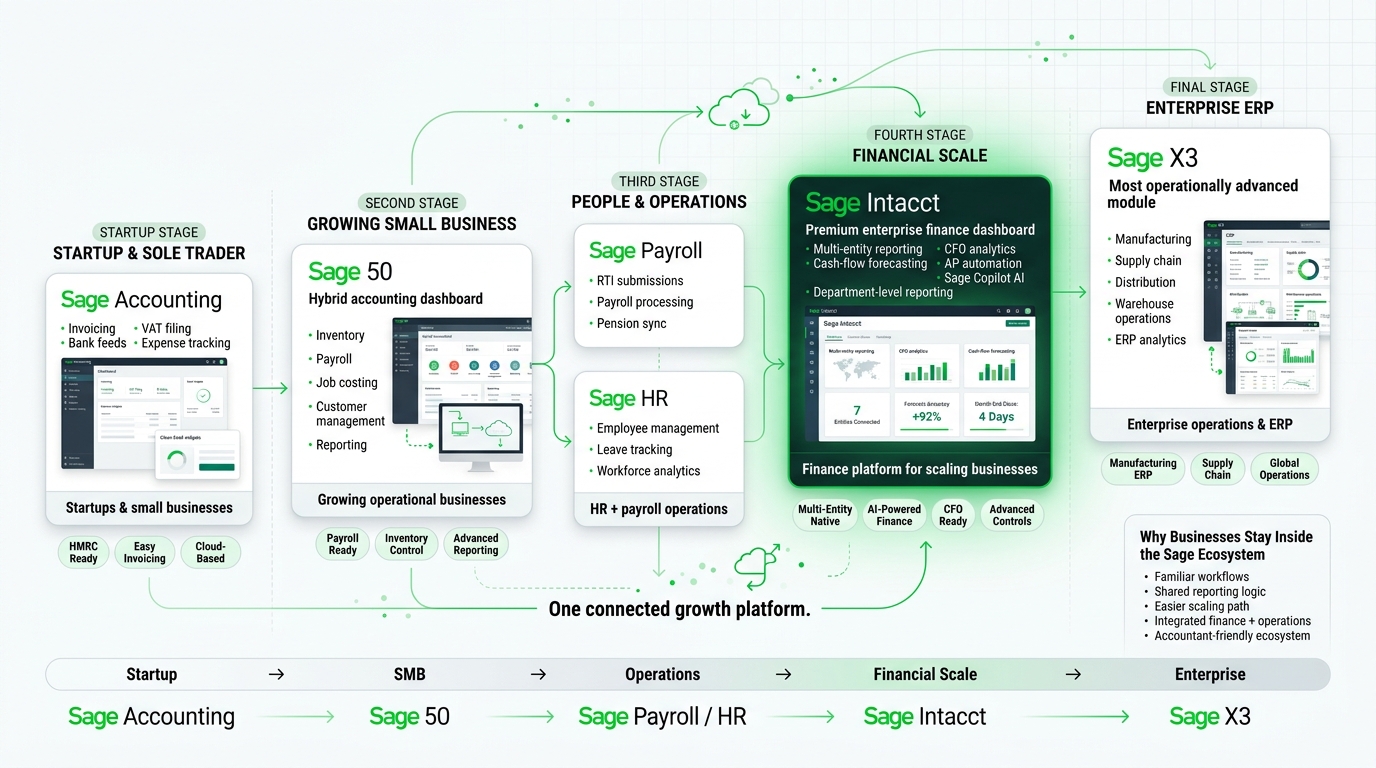
The real value of the Sage portfolio for UK businesses is that the products are designed to connect, so a business can grow without having to re-platform. The table below shows the typical journey.
Stage | Main Sage product | Natural add-ons | When to move up |
|---|---|---|---|
Self-employed / freelancer | Sage Sole Trader | None | When VAT registration or first employee is near. |
Small business / early Ltd | Sage Accounting (Start → Standard → Plus) | Sage Payroll, Sage HR | When stock, multi-user, or multi-currency needs grow. |
Established SMB (trade / wholesale) | Sage 50 | Sage Payroll, Sage HR | When multi-site, larger stock, or business intelligence is needed. |
Growing SME / multi-site | Sage 200 | Sage Payroll, Sage HR, Microsoft 365 | When multi-entity consolidation or complex reporting becomes core. |
Mid-market finance teams | Sage Intacct (or Sage Intacct Essentials) | Sage Payroll or 3rd-party payroll; Salesforce integration | When operational ERP depth is needed (manufacturing, distribution). |
Larger enterprise / international | Sage X3 | Sage People, Sage HCM | When Tier 1 scale is genuinely required. |
UK compliance coverage across Sage products
One of the reasons Sage stays strong with UK accountants is that compliance is baked in across the product line.
Compliance area | Where Sage covers it |
|---|---|
Making Tax Digital for VAT | Sage Accounting, Sage 50, Sage 200, Sage Intacct. |
Making Tax Digital for Income Tax | Sage Sole Trader, Sage Accounting, Sage for Accountants. |
PAYE RTI | Sage Payroll, Sage 50 Payroll. |
Auto-enrolment pensions | Sage Payroll, Sage 50 Payroll. |
CIS (construction) | Sage 50, Sage 200, Sage Intacct (configured). |
FRS 102 / IFRS reporting | Sage 200, Sage Intacct, Sage X3. |
Why it matters: a UK business that starts on Sage Accounting and grows to Sage Intacct can keep its HMRC submission workflow, its accountant relationship, and a consistent compliance posture the whole way through. That continuity is a genuine commercial advantage.
Where Sage fits best — and where it does not
The Sage portfolio is at its strongest when a UK business wants a trusted UK vendor, a clear growth path, and strong compliance. It is particularly attractive for VAT-registered businesses, multi-entity groups, and organisations where the accountant is already working inside Sage.
Where Sage is less obvious:
Very simple freelancers may prefer FreeAgent, especially where it is available through a banking partnership.
Very globally distributed groups sometimes prefer NetSuite for its strong international reach.
Manufacturing-heavy businesses may need Sage X3 specifically, not Sage Intacct, and should evaluate Microsoft Dynamics 365 and SAP alongside.
Choosing the right starting point
A simple way to pick your starting point in the Sage ecosystem:
Just you, no VAT, simple finances: Sage Sole Trader.
Small business, VAT-registered, limited users: Sage Accounting Start or Standard.
Small business with stock or multi-currency: Sage Accounting Plus.
Small business with employees: add Sage Payroll; consider Sage HR as team grows.
Established SMB with more structured accounting needs: Sage 50.
Growing SME needing finance plus commercial and stock: Sage 200 Standard or Professional.
Mid-market finance team, multi-entity, reporting-heavy: Sage Intacct (Essentials if scope is smaller).
Enterprise, manufacturing or multi-country: Sage X3.
Global mid-market HR: Sage People; watch Sage HCM for UK availability.
Accounting or bookkeeping practice: Sage for Accountants.
The Sage portfolio in 2026 is deliberately wide because UK businesses span everything from a single sole trader to a mid-market group with subsidiaries across Europe. Whether you start with Sage Sole Trader and grow over a decade into Sage Intacct, or come in at Sage 200 because that is where you are today, the value is in picking the tier that fits now and knowing exactly what the next step looks like.