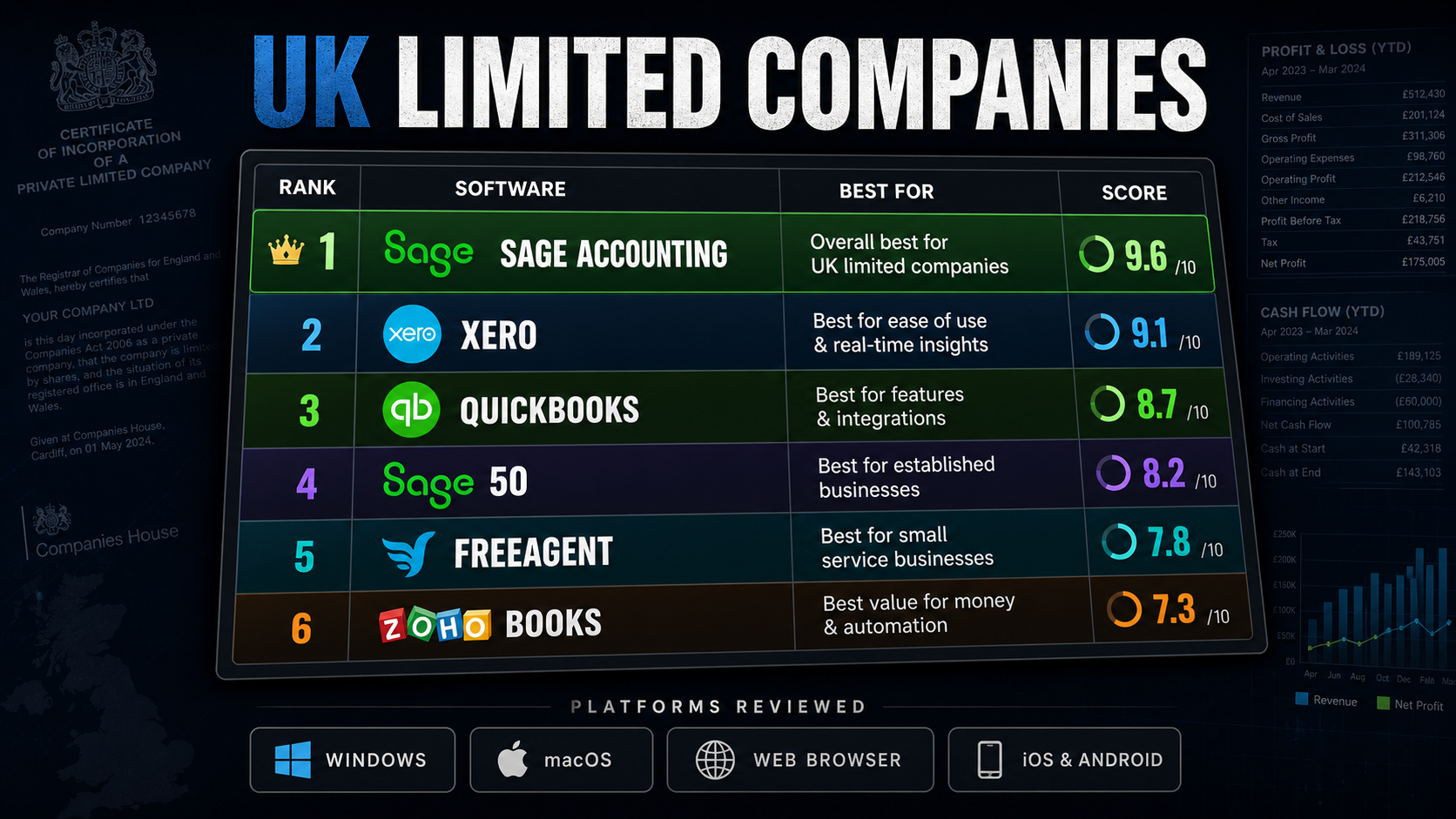
Running a UK limited company involves a set of compliance obligations that sole traders and partnerships simply do not face in the same way. Corporation Tax filing via CT600, statutory accounts submission to Companies House, dividend documentation for director-shareholders, payroll through RTI, and — increasingly — Making Tax Digital for VAT and Income Tax. The accounting software a limited company chooses has to handle all of that, or at least the parts that the business is not paying an accountant to handle. The ones that do not handle it well generate expensive surprises at year-end.
This ranked list covers the accounting software options that are genuinely worth evaluating for a UK limited company in 2026. The ranking is based on how well each platform handles the specific compliance and operational needs of a UK limited company — not on feature count, app store ratings, or marketing copy. Every price quoted is the standard monthly rate excluding VAT, without promotional discounts applied, because promotional pricing ends and the real price is what matters for budgeting.
What a UK Limited Company Actually Needs
Before ranking any software, it is worth being specific about what a limited company requires that other business structures do not. A sole trader needs invoicing, expense tracking, and Self Assessment support. A limited company needs all of that, plus:
Statutory accounts preparation — the annual accounts filed with Companies House in the required format
CT600 Corporation Tax return — filed with HMRC annually, and ideally prepared from the same data as the management accounts
Dividend documentation — recording distributions to shareholders with proper dividend vouchers that satisfy HMRC's requirements
Payroll — most limited company directors pay themselves a combination of salary and dividends, and the salary element requires RTI submission
VAT if applicable — MTD-compliant VAT return submission for VAT-registered companies
Multi-user access — company directors, a bookkeeper, and an external accountant often need simultaneous access
Audit trail integrity — a clear record of all financial transactions that stands up to HMRC scrutiny
The platforms ranked below are assessed against these requirements specifically. A platform that is excellent for sole traders but weak on CT600 filing or statutory accounts ranks lower in this list, regardless of how well-regarded it is in general comparisons.
1
FreeAgent — Best Overall for UK Limited Companies
Price: £33/month standard rate (currently £16.50/month for first six months), or free with a NatWest, RBS, Ulster Bank, or Mettle business current account
FreeAgent earns the top position in this list because it was built specifically for UK small businesses and freelancers, and its limited company feature set is the most complete of any platform at its price point. It is the only platform on this list that handles all five of a limited company's core compliance obligations — statutory accounts, CT600 filing, dividend documentation, payroll, and MTD VAT — within a single flat-rate subscription without add-ons.
The statutory accounts feature produces year-end accounts in the format required by Companies House and HMRC directly from the FreeAgent data. The CT600 Corporation Tax return is populated from the same accounts data and filed directly to HMRC from within the platform. These are not recent add-ons — they have been part of FreeAgent's core offering for years, built for the small limited company that wants to manage its own compliance without a full-service accountant handling year-end.
Payroll is fully included at the standard subscription price — RTI submissions, PAYE and National Insurance calculations, statutory payments, and payslips. The Tax Timeline, one of FreeAgent's signature features, shows the director a real-time view of upcoming PAYE, VAT, Corporation Tax, and Self Assessment liabilities in a single dashboard. For a company director who wants to see exactly what they owe and when, rather than being surprised by a tax bill, the Tax Timeline is one of the most practically useful features of any accounting platform in this market.
The bank partnership is a meaningful practical consideration. FreeAgent is free — permanently, not just as a trial — for business current account holders with NatWest, Royal Bank of Scotland, Ulster Bank, or Mettle. For a limited company that banks with one of these providers, the standard rate of £33 per month becomes £0 per month with no reduction in features. That is not a small difference, and for a new or early-stage limited company choosing its business bank account, the FreeAgent partnership is a legitimate factor in that decision.
The platform's UK-based support team, staffed by qualified accountants and bookkeepers, is consistently rated highly in user reviews. Support queries on FreeAgent typically go to people who understand UK tax and accounting rather than general customer service agents reading from scripts. For a limited company director doing their own bookkeeping, that specialist support matters when questions arise about how to categorise a transaction or handle an unusual VAT situation.
The limitation is scale. FreeAgent does not offer the multi-dimensional reporting, inventory management depth, or enterprise integration capabilities of Sage Standard or QuickBooks Advanced. For a limited company with complex inventory, multiple departments requiring separate P&L reporting, or a team that has outgrown a single-platform approach, FreeAgent is the wrong tool. For most UK limited companies with under twenty employees doing primarily service, consulting, or professional work, it is the most complete option available.
2
Zoho Books — Best Value for CT600 and Statutory Accounts
Price: Free plan available. Standard £12/month, Professional £24/month, Premium £30/month
Zoho Books ranks second specifically because of what its Standard plan includes at £12 per month. CT600 Corporation Tax filing and Final Accounts preparation — the two features most essential to a limited company's year-end compliance — are both available from the Standard plan. No other platform in this list offers that combination below £30 per month. For a limited company with a straightforward structure that wants to file its own year-end accounts and CT600 without an accountant, Zoho Books Standard at £12 per month is the most cost-effective compliant route available in 2026.
The free plan is also exceptionally capable and deserves specific mention. Zoho Books Free supports MTD for VAT filing directly to HMRC, bank reconciliation, Self Assessment preparation, over 50 financial reports, and one user plus one accountant access — at zero cost, permanently, with no invoice limits imposed per year. For a micro limited company in its first year that wants to keep costs minimal while maintaining proper accounting records, the free plan covers a substantial amount of ground.
Payroll is the gap that keeps Zoho Books off the top spot. No Zoho Books plan includes payroll — it is a separate Zoho Payroll subscription at every tier. For a limited company director paying themselves a salary, that is an additional subscription to manage alongside the accounting plan. The Zoho Payroll and Zoho Books integration works, but it is two products rather than one. FreeAgent bundles payroll into its single subscription price, which for most limited companies is a cleaner arrangement.
The Zoho ecosystem advantage is real for businesses that use or plan to use other Zoho tools. Zoho CRM, Zoho Expense, Zoho Projects, and Zoho Books share the same contact database and data infrastructure. For a limited company that is building its operational stack within the Zoho suite, the native integration between these tools is meaningfully tighter than any third-party connector can achieve. For a company not already using Zoho products, that advantage is less compelling.
Unlimited users at all plan levels — including the free plan — is a genuine practical advantage for limited companies where multiple people need access. A company director, bookkeeper, and accountant can all access Zoho Books on any plan without additional user licence costs. FreeAgent's standard plan also supports unlimited users, but Sage Start at £18 per month and QuickBooks Simple Start at £15 per month both restrict to one user — a real limitation for a limited company where the director and accountant both need access simultaneously.
3
Sage Accounting Standard — Best for Limited Companies with Employees
Price: Start £18/month (1 user). Standard £39/month (unlimited users, payroll included). Plus £59/month
Sage Accounting's Standard plan at £39 per month earns its ranking through the combination of features that matters most for a limited company with employees — unlimited users, flat-rate payroll for any number of employees, CIS contractor support, cash flow forecasting, and Sage Copilot's AI monitoring, all bundled into a single subscription.
The payroll on Sage Standard is the most comprehensive bundled payroll of any platform in this list. RTI submissions, PAYE and National Insurance, SSP, SMP, SPP, auto-enrolment with four workplace pension providers — NEST, NOW:Pensions, The People's Pension, and Smart Pension — automatic tax code updates, and digital payslips. All of this is inside the same interface as the accounting software, at a fixed price regardless of how many employees the company runs. For a limited company that has grown beyond its founder-director stage and is running a team on payroll, Sage Standard's unified payroll is meaningfully more efficient than managing a separate payroll subscription alongside an accounting subscription.
Sage Copilot, available across all Sage plans including the free Sole Trader tier, provides AI-driven monitoring that no other platform in this list currently matches in depth. Copilot monitors accounts proactively — flagging anomalies in reconciled transactions, identifying patterns that suggest errors, assisting with MTD submission workflows, and providing contextual financial insights in plain language on request. For a limited company director who reviews their own accounts without regular accountant oversight, this background monitoring reduces the risk of errors going undetected between formal review periods.
The limitation for Sage Accounting in the context of limited company compliance is that it does not include CT600 filing or statutory accounts preparation natively. Year-end compliance for a limited company using Sage Accounting typically requires either an accountant to prepare the CT600 and statutory accounts externally, or a separate HMRC-approved tool for those filings. FreeAgent and Zoho Books Standard both handle CT600 filing within the platform. For a limited company that wants to self-file year-end accounts, Sage Accounting is the wrong tool. For a limited company that uses an accountant for year-end compliance — which many do — the CT600 gap is an accountant's workflow problem rather than an operational one.
Sage's £18 Start plan deserves a note of caution for limited companies. It is restricted to one user, which means a director and an accountant cannot access the accounts simultaneously. For a limited company that needs to give both director and external accountant concurrent access, the Start plan forces an upgrade to Standard at £39 per month — more than doubling the monthly cost. That jump is worth factoring into any cost comparison that starts from the Start plan price.
4
QuickBooks Online — Best for Limited Companies Scaling to Mid-Market
Price: Sole Trader Plus £10/month. Simple Start £15/month. Essentials £28/month. Plus £38/month. Advanced £90/month. All prices exclude VAT.
QuickBooks Online ranks fourth rather than higher primarily because its payroll is a paid add-on at every plan level — including the £90 per month Advanced plan — rather than being bundled. For a limited company comparing total cost of ownership including payroll, QuickBooks typically works out more expensive than Sage Standard or FreeAgent when payroll is included. The platform is strong on AI capabilities, user experience, and reporting depth, and for a limited company that prioritises those dimensions and manages payroll separately, the ranking could move upward depending on specific needs.
QuickBooks' Intuit Intelligence suite is among the most developed AI feature sets in the UK accounting software market. Accounting AI monitors bank feeds and identifies categorisation anomalies. VAT AI catches discrepancies before filing. Finance AI analyses KPIs and supports scenario planning. Customer AI manages leads and follow-ups. The depth and breadth of the AI layer goes further than Sage Copilot in terms of feature variety, though Sage Copilot's autonomy — the ability to take actions on behalf of the user rather than just surfacing insights — remains a differentiator.
QuickBooks Plus at £38 per month is the plan that makes the strongest case for most growing limited companies. It supports five users, includes class and location tracking — the equivalent of Sage's analysis types — project profitability reporting, inventory management, budgeting, and the full Intuit Intelligence suite. At £38 per month against Sage Standard at £39 per month, the price is near-identical. The decision between them comes down to whether the limited company needs payroll bundled (Sage wins) or prioritises QuickBooks' broader AI feature set and CRM-adjacent capabilities.
The Advanced plan at £90 per month is positioned for limited companies that have grown beyond the capacity of typical small business software. Twenty-five users, custom roles and permissions, workflow automation, batch invoice processing, revenue recognition, custom report builder, Excel sync, and dedicated Customer Success Manager support. For a limited company that has reached fifteen to twenty employees and is approaching mid-market complexity, QuickBooks Advanced provides a genuine alternative to stepping up to Sage Intacct or NetSuite. UK phone support is available seven days a week on all plans — Saturday and Sunday included — which is a practical advantage over platforms that restrict weekend support to message-only channels.
QuickBooks does not include CT600 or statutory accounts filing. Like Sage Accounting, year-end compliance for a limited company requires either an accountant or a separate HMRC-approved tool. For a limited company that self-files, FreeAgent or Zoho Books Standard are the more complete options at year-end.
5
Xero — Best for Accountant-Managed Limited Companies
Price: Starter £16/month. Standard £33/month. Premium £47/month. Ultimate £59/month. All prices exclude VAT.
Xero ranks fifth not because it is a weak platform — it is one of the most technically polished cloud accounting products in the market — but because in the specific context of UK limited company compliance, it requires more reliance on an external accountant to complete the compliance picture than the platforms ranked above it. Xero does not include payroll natively at any plan level in the UK: Xero Payroll is a paid add-on. It does not include CT600 or statutory accounts filing. Year-end compliance for a Xero-using limited company requires an accountant with access to Companies House filing tools or separate statutory accounts software.
Where Xero genuinely excels — and why it holds fifth place rather than lower — is in the accountant relationship. Xero's practice management tools for accountants are among the best in the market, and the platform has built a large network of Xero-certified accountants in the UK. For a limited company that uses an accountant actively, Xero's collaboration features, shared ledger access, and bank feed reliability make it an excellent platform from the accountant's perspective. Many UK accountancy practices work primarily or exclusively in Xero and recommend it to all clients. For a limited company following its accountant's software recommendation, Xero is a well-supported choice.
Xero's bank reconciliation is consistently rated among the best implementations in the market. The matching algorithm, bank rule system, and reconciliation interface have been refined over many years and handle most common transaction patterns accurately. For a limited company that processes a high volume of bank transactions and wants reconciliation to be fast and low-effort, Xero's reconciliation performance is a genuine advantage. Its app marketplace is also one of the broadest, covering integrations with over a thousand third-party tools including specialist industry platforms that may not have pre-built connections with Sage or QuickBooks.
The invoice cap on the Starter plan — fifty invoices per month — is a real constraint for active limited companies and forces an upgrade to Standard at £33 per month, the plan that supports unlimited invoicing and three users. For most limited companies, Standard is the minimum practical plan, and at £33 per month plus the Xero Payroll add-on for director salary, the monthly cost exceeds FreeAgent's standard rate of £33 per month with payroll already included. The total cost comparison, when payroll is included, runs in FreeAgent's favour for most small limited companies with straightforward needs.
6
Clear Books — Best for Simple Limited Companies on a Budget
Price: Small £16/month (unlimited users). Large £44/month. Payroll is a separate add-on.
Clear Books ranks sixth with a specific qualification: for a simple UK limited company with one or two director-shareholders, no employees, and low transaction volume, the Small plan at £16 per month with unlimited users represents very good value that the platforms ranked above it do not match at the same price point. Invoicing, bank feeds, bank reconciliation, VAT returns with HMRC MTD filing, a full suite of financial reports including balance sheet and profit and loss, receipt scanning, and the Dividends tool — all included at £16 per month with no user limits.
The Dividends tool is the feature that elevates Clear Books for limited company directors specifically. Most limited company owner-directors pay themselves partly through dividends, which must be properly documented to satisfy HMRC requirements. Clear Books generates dividend vouchers and records the distribution correctly in the accounts from a structured workflow, rather than requiring a manual journal entry that many non-accountant directors find confusing. This is a feature that Sage Accounting, QuickBooks, and Xero do not include as an explicit tool at any plan level.
Clear Books does not include CT600 filing or statutory accounts preparation. Year-end compliance requires an accountant or external tool. Payroll is a separate add-on subscription. For a limited company with any employees, the total cost of Clear Books Small plus payroll exceeds the cost of FreeAgent at £33 per month, which bundles payroll and includes more complete compliance features. Clear Books' competitive advantage is its price-to-feature ratio for the specific user profile of a small limited company with no employees, where unlimited users and the dividends tool at £16 per month represent a combination no other platform offers at that cost.
Quick Comparison
Platform | Starting Price | CT600 Filing | Payroll Included | Dividend Tool | Users |
|---|---|---|---|---|---|
FreeAgent | £33/mo (free w/ NatWest) | Yes — included | Yes — included | No dedicated tool | Unlimited |
Zoho Books Standard | £12/mo | Yes — included | No — add-on | No dedicated tool | 3 users |
Sage Standard | £39/mo | No — external | Yes — included | No dedicated tool | Unlimited |
QuickBooks Plus | £38/mo | No — external | No — add-on | No dedicated tool | 5 users |
Xero Standard | £33/mo | No — external | No — add-on | No dedicated tool | 3 users |
Clear Books Small | £16/mo | No — external | No — add-on | Yes — included | Unlimited |
What the Ranking Does Not Cover
This list does not include Sage 50 or Sage Intacct, both of which are appropriate for UK limited companies that have outgrown the cloud-based small business platforms reviewed here. Sage 50 is a desktop-first product aimed at companies with more complex accounting needs — multi-company consolidation, advanced stock control, detailed job costing — at a price point starting from £103 per month. Sage Intacct is a full financial management platform for growing mid-market businesses, typically at £400 per month and above, and is covered separately in the Sage Intacct vs NetSuite comparison.
It also does not rank free-only tools like Wave, which does not support MTD VAT filing in the UK and lacks the compliance infrastructure that a UK limited company requires. Tools that are not HMRC-recognised for MTD are not appropriate for VAT-registered limited companies in 2026.
The Bottom Line
For most UK limited companies, the decision narrows to three platforms depending on their specific profile. A limited company with employees that wants payroll bundled and AI-driven account monitoring should look most closely at FreeAgent and Sage Standard — FreeAgent if CT600 self-filing is important, Sage Standard if CIS, pension breadth, and Copilot's autonomous capabilities are the priority. A limited company without employees that wants to keep monthly costs minimal while retaining the ability to self-file the CT600 should look at Zoho Books Standard at £12 per month first. A limited company with a NatWest, RBS, or Mettle business account should start with FreeAgent's free tier before evaluating anything else.
The platforms that score poorly on this specific comparison — because they require add-ons, external tools, or accountant involvement to complete the limited company compliance picture — are not bad platforms. Xero and QuickBooks are excellent accounting tools with large partner networks and mature feature sets. They simply require a more active accountant relationship to handle year-end compliance, which is a reasonable model for many businesses. For a limited company that already uses an accountant regularly and wants the accountant to handle year-end, Xero or QuickBooks may well be the right choice on other grounds. For a limited company trying to do more of its compliance in-house and keep accountancy costs down, FreeAgent or Zoho Books Standard is the more complete self-contained package.