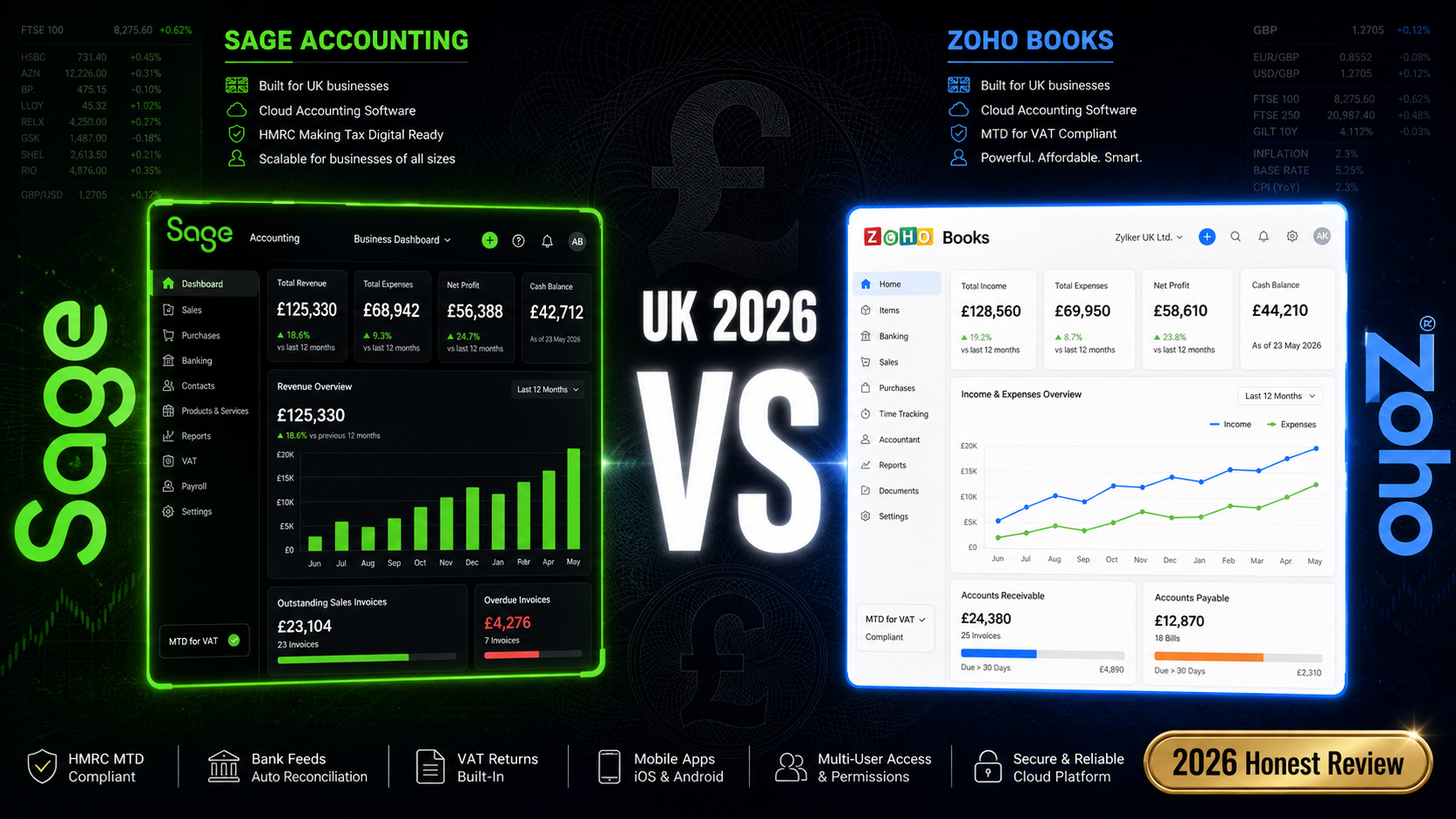
Sage and Zoho Books both target small businesses, both sit at the lower end of the UK accounting software market, and both describe themselves as easy to use. Beyond those surface similarities, they are built on meaningfully different philosophies — and for UK businesses in particular, those differences are not cosmetic. One is a platform designed and optimised for the UK market, with HMRC integration at its core. The other is a globally distributed product with a strong UK localisation layer and a genuinely compelling free plan that is often underestimated in comparison guides.
This comparison works through every dimension that actually matters when choosing between them — pricing, HMRC compliance, payroll, reporting, integrations, and the practical experience of running your accounts day to day. It does not pad things out with vague feature labels. If two features work the same way on both platforms, that is what it will say.
Pricing
Pricing is where the comparison becomes immediately interesting, because both platforms offer free plans — but the free plans are structured differently, and the value-for-money calculation shifts depending on how many users you need and whether payroll is in scope.
Platform & Plan | Monthly (excl. VAT) | Users | Payroll | Key Features |
|---|---|---|---|---|
Sage Free (Sole Trader) | £0 | 1 | Not included | Invoicing, expenses, bank feeds, MTD for ITSA, Copilot AI |
Sage Start | £18 | 1 | Not included | VAT returns, bank reconciliation, unlimited invoices, MTD |
Sage Standard | £39 | Unlimited | Included — flat rate | Payroll, CIS, cash flow forecasting, advanced reports |
Sage Plus | £59 | Unlimited | Included — flat rate | Multi-currency, inventory, budgeting, all Standard features |
Zoho Books Free | £0 | 1 user + 1 accountant | Not included | Invoicing, VAT returns, MTD for VAT, Self Assessment (SA103), bank reconciliation, 50+ reports |
Zoho Books Standard | £12 (£10 annual) | 3 users | Not included | Bank feeds, Final Accounts filing, CT600 filing, custom reports, API access |
Zoho Books Professional | £24 (£20 annual) | 5 users | Not included | CIS returns to HMRC, multi-currency, inventory, project tracking, purchase orders |
Zoho Books Premium | £30 (£25 annual) | 10 users | Not included | Cash flow forecasting, fixed assets, budgets, vendor portals, custom modules |
Zoho Books Elite | £99 (£85 annual) | 10 users | Not included | Advanced inventory, warehousing, serial/batch tracking, Shopify, eBay, Amazon |
Zoho Books Ultimate | £199 (£165 annual) | 15 users | Not included | Advanced analytics, 50+ data visualisations, Zoho Analytics integration |
At first glance, Zoho Books looks cheaper across most tiers. £12 per month for the Standard plan versus Sage's £18 Start tier is a real difference. At the Professional level, £24 per month against Sage's £39 Standard, Zoho Books appears to offer more features for less. But that comparison requires careful reading, because neither Zoho Books plan includes payroll — at any tier, including the £199 per month Ultimate plan. Payroll in the Zoho ecosystem is a separate product, Zoho Payroll, which adds to the monthly cost and requires a separate login and workflow. Sage bundles payroll into the Standard plan at a flat monthly rate regardless of how many employees you have.
The practical implication is significant. A UK business with ten employees using Zoho Books Professional at £24 per month adds Zoho Payroll on top — a separate subscription, separately managed. A business on Sage Standard at £39 per month gets full payroll, pension auto-enrolment with four providers, RTI submissions, and payslips for any number of employees, all inside the same product. At five or more employees, Sage's all-in pricing typically works out cheaper or equivalent to Zoho's split structure. At twenty employees, Sage is materially cheaper.
Zoho Books does have one exceptional strength here that most comparisons understate. Its free plan is among the most genuinely functional free accounting plans in the UK market. Where Sage's free plan is aimed at sole traders only, Zoho Books' free plan supports not just invoicing and expenses but VAT returns with HMRC direct filing, bank reconciliation, Self Assessment preparation for sole traders (SA103F and SA103S), CIS contractor tracking, and over 50 financial reports — all at no cost. For a very early-stage business, micro-freelancer, or business owner testing the platform before committing, that is a serious amount of capability for nothing.
The number that matters
For businesses without employees, Zoho Books is cheaper at most paid tiers. For businesses with employees who want payroll integrated at a flat rate, Sage Standard is more cost-effective at almost every headcount. The decision splits along that single axis more cleanly than most comparisons acknowledge.
HMRC Compliance and Making Tax Digital
This is one of the most consequential differences between the two platforms for UK businesses, and it is frequently glossed over in comparison guides that treat the two products as equivalent on compliance. They are not.
Sage is an HMRC-approved provider for Making Tax Digital for VAT and for MTD for Income Tax Self Assessment. Its MTD credentials are listed directly on the HMRC website, covering digital record keeping, quarterly updates for self-employment, and tax estimates from HMRC based on submitted updates. Sage Copilot — included on every plan including the free Sole Trader tier — assists with preparing and submitting quarterly income updates to HMRC under MTD for Income Tax. The compliance workflow is integrated into the core product, not bolted on as an afterthought.
Zoho Books is also HMRC-listed, but its listed features are categorised differently. HMRC's register describes Zoho Books as supporting record keeping and simplified expenses — not the full suite of digital updates and tax estimate features listed against Sage. Zoho Books does file MTD for VAT returns directly to HMRC, and the platform has been updated to support quarterly MTD for Income Tax updates as required from April 2026. Its free plan also now includes the ability to prepare Self Assessment returns for sole traders — SA103F for full expenses and SA103S for simplified expenses — which is a substantive update that closes a gap with Sage's sole-trader offering.
Where Sage has the edge is in the automation of the compliance process. Sage Copilot monitors accounts proactively, flags anomalies before they become problems, and assists with MTD submissions in a way that requires minimal manual input from the business owner. Zoho Books handles the same compliance obligations technically but requires more active management of the workflow. For an owner-managed business without a dedicated accountant reviewing accounts regularly, that difference in active versus passive compliance support is meaningful. For a business with an accountant managing the books, both platforms file the same returns to the same HMRC systems — and the automation advantage becomes less material.
On Corporation Tax, Zoho Books Standard adds something Sage does not currently offer natively at an equivalent price point: CT600 filing directly through the software from the Standard plan at £12 per month. For limited companies wanting to file their Corporation Tax return without a separate tool or accountant, that is a genuine advantage. Sage does not currently include integrated CT600 filing within Sage Accounting — it is handled through Sage's accountant-facing tools or separately. If CT600 self-filing within the accounting platform is important to you, Zoho Books has a real lead here.
Payroll
Payroll is the single most important practical difference between these two platforms for businesses with employees, and it is worth treating in full rather than noting briefly and moving on.
Sage includes payroll natively within the Standard plan at £39 per month. The payroll feature handles RTI submissions to HMRC, PAYE and National Insurance calculations, statutory payments including SSP, SMP, and SPP, auto-enrolment with four workplace pension providers — NEST, NOW:Pensions, The People's Pension, and Smart Pension — automatic tax code updates, and digital payslips. All of this runs inside the same interface as the accounting software. There is no separate login, no data transfer between platforms, no risk of payroll journals not reconciling with the accounts. The price is fixed regardless of how many employees you run — one employee or fifty pays the same £39 per month for Standard.
Zoho Books does not include payroll. Zoho does offer Zoho Payroll as a separate product in its suite, but it is licensed and managed independently of Zoho Books. The integration between Zoho Payroll and Zoho Books works — payroll journals post to the accounts — but it is an integration between two separate products rather than a single unified system. That distinction matters in practice: you manage two separate subscriptions, potentially with two separate support queues, and you introduce a synchronisation dependency that can cause reconciliation issues if one system gets out of step with the other.
For a sole trader or very early-stage business with no employees, this difference is completely irrelevant. For any business with employees, it is the deciding factor in the cost comparison. At any team size above one, Sage Standard's all-in payroll at a flat rate works out cheaper than Zoho Books Professional plus Zoho Payroll. The gap is not marginal — it is structural and widens as the team grows.
Pension provider breadth also matters. Sage's four native pension connections — NEST, NOW:Pensions, The People's Pension, and Smart Pension — mean that if your business uses any of the UK's major auto-enrolment providers, the contribution calculations and submissions happen inside Sage without manual intervention. Zoho Payroll's UK pension integrations are more limited. For businesses that have already established an auto-enrolment scheme with a provider other than NEST, that is a practical workflow consideration.
Bank Reconciliation
Bank reconciliation is where both platforms perform competently for the majority of UK small businesses, but with meaningful differences in how they approach automation and anomaly detection.
Zoho Books connects to UK banks via bank feeds and supports import of bank statements in CSV and OFX formats. The reconciliation interface is clean and well-designed. Bank rules can be set up to automatically categorise recurring transactions — once rules are in place, common transactions categorise without manual review. The interface is clearly built for non-accountants, using plain language rather than accounting terminology, and the reconciliation workflow is straightforward to navigate. For a business owner doing their own bookkeeping a couple of times per month, Zoho Books' reconciliation experience is smooth and accessible.
Sage's reconciliation workflow is comparable in speed and accuracy for typical transaction volumes, but Sage Copilot adds a dimension that Zoho Books does not currently replicate. Copilot monitors your categorised and reconciled transactions and proactively flags anomalies — transactions that look out of pattern relative to historical data, potential duplicates, unusual amounts in familiar merchant categories. For a business owner reviewing their accounts without a second pair of professional eyes, this background monitoring acts as a soft error-detection layer. It does not replace an accountant's review, but it does catch a category of errors that manual reconciliation alone would miss.
Both platforms support bulk reconciliation and batch matching. Both connect reliably to major UK banks including Barclays, HSBC, Lloyds, NatWest, Santander, and a range of challenger banks. Neither platform has a meaningful edge on the mechanical reliability of bank feed connectivity in the UK market. The difference is in what happens after the transactions are imported — Sage's AI monitoring versus Zoho Books' rule-based automation.
Invoicing
Both platforms handle invoicing well, and for a typical small business sending a few dozen invoices per month, either platform will do the job without friction. The differences come down to invoice caps, automation flexibility, and where each platform's strengths lie.
Zoho Books imposes annual invoice limits by plan. The free plan allows up to 1,000 invoices per year — roughly 83 per month, which is sufficient for many small businesses. The Standard plan raises this to 5,000 annually, Professional to 10,000, and Premium to 25,000. For most UK small businesses these limits are not a constraint, but for businesses with high invoice volumes — agencies billing multiple projects monthly, or e-commerce businesses issuing invoices with each order — the caps are worth checking against actual transaction volume before committing to a plan.
Sage imposes no invoice volume caps on any paid plan, including the £18 Start tier. For a business that sends a high volume of invoices and wants pricing certainty, that distinction matters.
Zoho Books' invoicing module is feature-rich. Quotes convert to invoices with a single click. Recurring invoices are configurable and reliable. The client portal — where customers can log in to view outstanding invoices, download statements, and make payments directly — is one of the cleaner implementations in the UK market at this price point. Payment integrations with Stripe, GoCardless, Square, PayPal, and Razorpay are all available. Automated payment reminders are configurable at multiple intervals and can be customised with different messaging for different customer groups.
Sage's invoicing is competent and includes Copilot-powered chasing — context-aware reminders that adapt based on invoice age and client payment history rather than firing at fixed intervals. The practical difference between the two invoicing implementations is not large for most businesses. Zoho Books' client portal is slightly more polished and its payment gateway breadth is slightly wider. Sage's AI-driven payment chasing is more adaptive than Zoho's rule-based reminders. Both cover what a UK small business actually needs.
Reporting
Both platforms offer the standard management accounts suite — profit and loss, balance sheet, cash flow statement, aged debtors, aged creditors, and a range of transaction-level reports. For routine reporting needs, either platform produces the output a bank manager, external accountant, or company director would expect.
Zoho Books' reporting is notable for two things. First, it includes over 50 financial reports across all plans including the free tier — a breadth that is genuinely impressive at zero cost. Reporting tags, available from the Standard plan, allow transactions to be associated with custom dimensions and then filtered in reports — the equivalent of Sage's analysis types, implemented in a slightly different but comparable way. Second, Zoho Books Standard at £12 per month now includes Final Accounts preparation and CT600 filing directly within the platform. For a small limited company wanting to produce its own accounts without an accountant, the combination of management accounts, final accounts preparation, and CT600 filing in a single platform is a genuinely differentiated offering at that price point.
Sage Accounting offers analysis types from the Standard plan that allow detailed departmental and project-level segmentation across all core reports. For businesses that need to track profitability by department, cost centre, or project alongside the standard P&L, Sage's implementation is clean and powerful. Budget versus actual reporting is available from Sage Plus. Cash flow forecasting is built into Sage Standard. Sage Copilot can also be prompted to surface specific insights from your financial data in plain language, which is useful for business owners who want to understand performance without running reports manually.
The reporting comparison ultimately depends on what a given business needs. For a micro-business or sole trader wanting maximum reporting capability at minimum cost, Zoho Books' free plan with 50+ reports is the stronger offer. For a growing business needing departmental segmentation, proactive anomaly detection in reports, and integrated cash flow forecasting, Sage Standard is the more rounded package.
Integrations and the Zoho Ecosystem
This is the dimension where Zoho Books has an advantage that is easy to understate if you are not already a Zoho customer — and easy to overstate if you are.
Zoho Books is one part of a much larger suite of business software. Zoho offers CRM, project management, HR, marketing automation, customer support, payroll, expenses, analytics, inventory management, and a range of other tools — all built by the same company on the same platform, sharing the same contact database, the same user authentication, and the same data infrastructure. If your business already uses Zoho CRM or intends to, Zoho Books integrates with it natively and deeply. Customer records, invoices, quotes, and payments flow between the two systems without requiring a third-party connector. The same applies to Zoho Expense, Zoho Projects, Zoho Inventory, and Zoho People. For a business building its entire operational stack within the Zoho ecosystem, the integration is genuinely seamless in a way that no external accounting integration can replicate.
Zoho Books also integrates with third-party tools outside its own ecosystem — Stripe, Square, Zapier, Slack, Google Drive, Shopify, eBay, Amazon, and Etsy. The breadth is competitive with other mid-market platforms.
Sage's third-party integration library covers the major tools UK small businesses actually use — payment processors, CRM tools, e-commerce platforms, and specialist industry software — through the Sage App Marketplace. The native integration with Sage's own payroll and HR products is tight and eliminates the reconciliation issues that can arise from connecting third-party payroll tools. For a business not already invested in the Zoho ecosystem, the integration arguments for Zoho Books are less compelling, because the advantage lies primarily in connecting to other Zoho products that the business may not be using.
The honest assessment: if you use Zoho CRM or multiple other Zoho tools, Zoho Books is the stronger choice on integrations by a clear margin. If you are not already in the Zoho ecosystem, the integration argument is closer to neutral, and the decision comes down to other factors.
CIS for Construction Businesses
The Construction Industry Scheme is a significant consideration for any UK business involved in construction — whether as a contractor, subcontractor, or both. It is also an area where the platforms diverge in capability in ways that matter operationally.
Sage handles CIS comprehensively and natively within its Standard plan. CIS deductions are calculated automatically on qualifying payments to subcontractors. Monthly CIS returns are filed directly to HMRC from within the software. Contractor and subcontractor statements are generated automatically. The entire workflow, from identifying qualifying payments through to HMRC submission, runs inside the same interface as payroll and accounts without requiring a separate add-on or manual calculation.
Zoho Books Professional includes CIS returns to HMRC, which is more than many competing platforms at the same price point. It handles CIS deductions and allows direct CIS return submission. However, the implementation is less deeply embedded than Sage's — for high-volume construction businesses running complex contractor and subcontractor relationships across multiple projects, Sage's native CIS workflow is more robust. For a small construction business with straightforward CIS needs, Zoho Books Professional's implementation is adequate.
For any UK construction business for which CIS is a significant operational concern, Sage Standard is the more reliable choice. The depth of Sage's CIS integration — combined with the native payroll that handles PAYE and CIS in the same workflow — is difficult to replicate through Zoho Books' current implementation.
Mobile
Both platforms have mobile apps for iOS and Android, but the user ratings diverge sharply and are worth paying attention to.
Zoho Books' mobile app is rated 4.8 on the iOS App Store and 4.8 on Google Play with a substantial number of reviews. The app supports invoicing, expense capture, bank transaction categorisation, project time tracking, and access to reports. It is consistently described by users as one of the strongest mobile accounting experiences in the market at this price tier, and the ratings reflect that. For a business owner who does significant accounting admin from a phone, Zoho Books' mobile app is one of the better options available.
Sage's mobile app is rated 4.5 on iOS. Its Android rating is notably lower — 2.9 stars from a smaller review base — which reflects a pattern of Android users reporting stability issues over the past two years. The iOS app is functional and handles invoicing, expenses, and Copilot access reliably. For Android-primary users, the gap between Zoho Books' mobile experience and Sage's is material and worth factoring into the decision. For iOS users, both platforms deliver a capable mobile experience with Zoho Books slightly ahead on ratings.
Support
Both platforms offer email, phone, and live chat support, but the structure differs in ways that matter depending on the kind of help you are likely to need.
Sage provides UK phone support on all paid plans, staffed by people who are familiar with UK-specific accounting and tax questions — VAT treatments, CIS queries, MTD compliance questions. Sage's support infrastructure is backed by a large partner network of UK accountants and bookkeepers, and its Sage Central community and knowledge base are well-maintained. For a UK small business encountering a question that is specific to the UK regulatory environment, Sage's support quality on those queries is high.
Zoho Books offers email, voice, and chat support from the Standard plan upward, and email-only on the free plan. UK-specific support is available via a dedicated UK contact line and email address. The support quality is generally well-regarded, but Zoho Books is a global product with global support teams. For questions that are specific to UK payroll, MTD, or CIS, the depth of institutional knowledge within Sage's support team is likely to be greater — simply because these are regulations that affect only the UK market and Sage has decades of experience navigating them.
For straightforward accounting queries, both platforms support effectively. For questions at the intersection of UK tax law and specific software behaviour — the kind that come up during a payroll run that goes wrong or an MTD deadline that is approaching — Sage's specialist UK knowledge gives it a practical support advantage.
Inventory Management
For product-based businesses tracking physical stock, the inventory capabilities of both platforms are worth examining carefully, because the gap between the two is more significant than their price points suggest.
Zoho Books' inventory management is well-developed and scales substantially with plan tier. From the Professional plan at £24 per month, it supports item tracking, stock level monitoring, reorder point alerts, price lists, and purchase order management. The Elite plan at £99 per month adds advanced inventory control — warehouse management, composite items, serial number tracking, batch tracking, and multi-channel e-commerce integration with Shopify, Amazon, eBay, and Etsy. For a product business that needs serious inventory infrastructure without buying dedicated inventory software, Zoho Books Elite is a strong option.
Sage Plus at £59 per month includes inventory management — item tracking, stock levels, and basic purchase order management — but without the depth of Zoho's Elite tier. For businesses that need multi-channel e-commerce integration, warehouse management, or batch and serial number tracking, Sage Accounting is not the right tool. Those businesses would look to Sage 50 or a specialist inventory system. For product-based businesses where inventory management is a significant operational requirement, Zoho Books Elite provides a more complete solution within the Zoho ecosystem than Sage Accounting can at any price tier.
Who Each Platform Is Best For
Choose Sage if
You have employees and want payroll bundled at a fixed monthly rate without a separate subscription
You operate in UK construction and need integrated CIS deductions, returns, and HMRC submissions
You want AI that monitors your accounts proactively and acts autonomously on compliance and invoice chasing
You are a sole trader who wants MTD for Income Tax support and a free plan that does not require a bank relationship to qualify
You use workplace pensions with NOW:Pensions, The People's Pension, or Smart Pension
You want UK phone support from people who understand UK-specific payroll and tax questions in depth
Your accounts do not require advanced inventory management or multi-channel e-commerce stock control
Choose Zoho Books if
You are a micro-business, sole trader, or early-stage company who wants the most capable free accounting plan in the UK market
You are a limited company that wants to file CT600 returns and prepare final accounts directly within the software at a low monthly cost
You already use or plan to use Zoho CRM, Zoho Expense, Zoho Projects, or other Zoho tools
You run a product-based business with significant inventory requirements and want advanced stock management or e-commerce integration
You primarily use an Android phone for business admin and want a stronger mobile experience
You do not have employees or are comfortable managing payroll through a separate Zoho Payroll subscription
You want the flexibility of a tiered platform that scales from free to enterprise without switching software
The Bottom Line
The headline comparison is deceptively simple: Zoho Books is cheaper at almost every tier for businesses without employees, while Sage is cheaper and more complete for businesses with employees. That is the core of the decision for most UK small businesses, and it holds up under scrutiny.
Zoho Books' free plan is, without qualification, one of the best free accounting plans available to UK businesses in 2026. The inclusion of MTD for VAT filing, Self Assessment preparation, CIS contractor tracking, and 50+ reports at no cost gives a micro-business or sole trader more accounting infrastructure for free than most competing platforms currently offer. If your business is very small, has no employees, and does not need payroll, the case for paying for something else is harder to make than many comparison articles admit.
Where Zoho Books loses ground is on UK operational depth. It does not include payroll. Its CIS implementation, while improving, is not as deeply embedded as Sage's. Sage Copilot's autonomous behaviour — monitoring, flagging, chasing, and assisting with submission — reduces the overhead of staying compliant in a way that Zoho Books' more manual workflow does not. And for any business that needs to speak to someone who understands UK payroll, CIS, or MTD in detail, Sage's support infrastructure has more specialist depth.
The Zoho ecosystem argument is real but conditional. If you are building a business stack around Zoho products, Zoho Books is the natural centre of that system and its integrations are genuinely seamless in a way third-party connections cannot match. If you are not already in the Zoho ecosystem, that advantage largely disappears, and the decision comes down to core accounting functionality, payroll cost, and HMRC compliance depth — all of which favour Sage for businesses of any meaningful size.
Both platforms are well-built, actively developed, and HMRC-recognised. The right choice is the one that matches your business today and leaves room for where it is going.