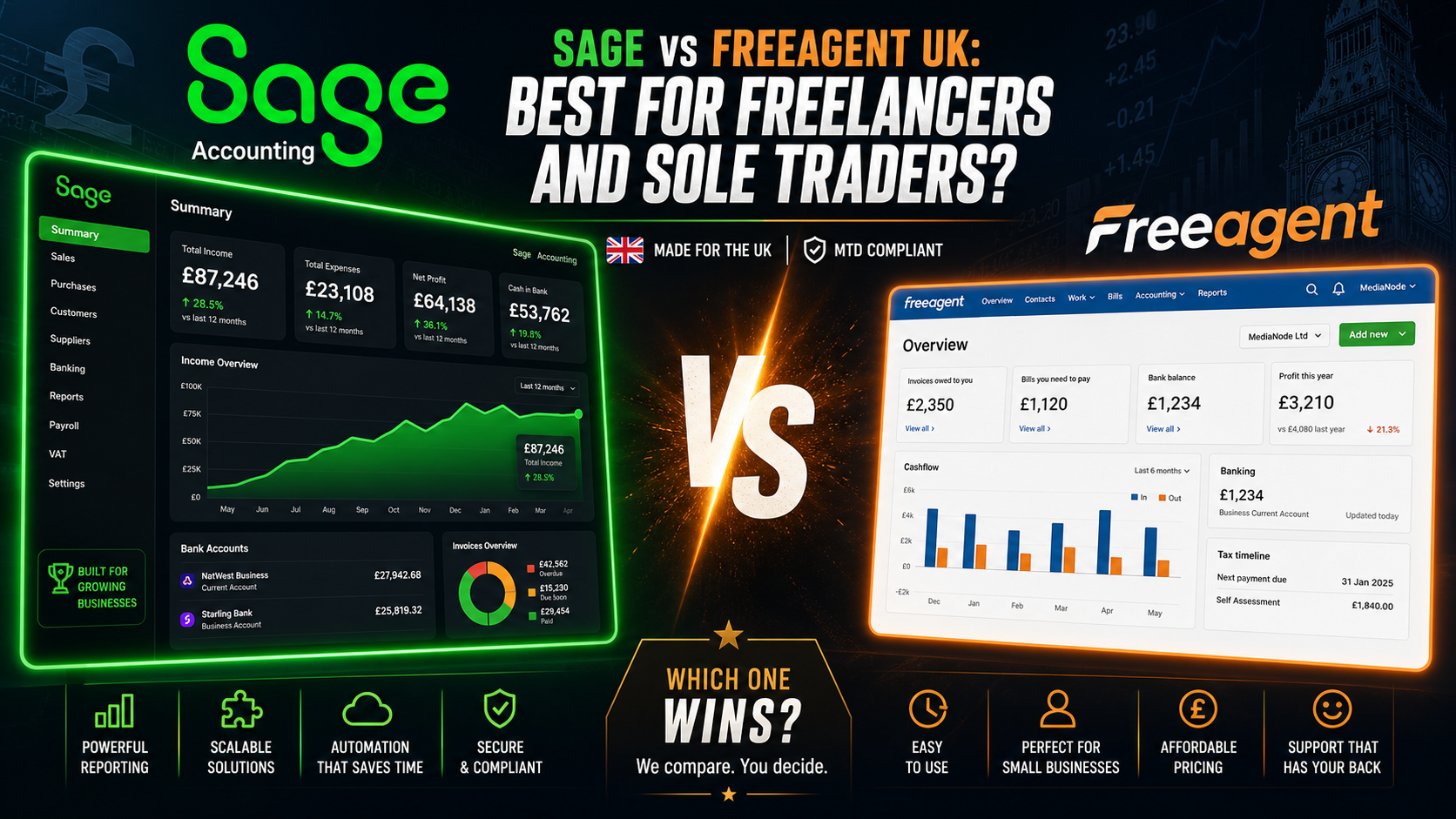
Sage and FreeAgent occupy different corners of the UK accounting software market — but for freelancers and sole traders, they overlap more than either company would care to admit. FreeAgent was built from the ground up for the self-employed: a single-person business submitting a Self Assessment, chasing invoices, and dreading the January tax deadline. Sage, in contrast, is a platform that serves businesses from sole traders up to mid-market companies, and has spent the past two years adapting its entry-level offering to compete directly on the ground FreeAgent has owned for years.
The question for a freelancer or sole trader choosing between them in 2026 is not which platform has the longer feature list. It is which one handles the specific work of running a one-person UK business — tax compliance, invoice chasing, cash flow visibility, Self Assessment — with the least friction and the best value for money. This guide works through that question directly.
Pricing
This is where the comparison gets immediately interesting, because the headline numbers do not tell the full story in either direction.
Platform & Plan | Monthly (excl. VAT) | Payroll Included | Key Features |
|---|---|---|---|
Sage Free (Sole Trader) | £0 | Not included | Invoicing, expenses, MTD for ITSA, Copilot AI, bank feeds |
Sage Start | £18 | Not included | Bank feeds, VAT returns, MTD, unlimited invoices, Copilot AI |
Sage Standard | £39 | Included — flat rate, no per-employee cost | Full payroll, CIS, cash flow forecasting, advanced reporting |
FreeAgent | Varies by entity type and billing cycle | Included | MTD for ITSA and VAT, Self Assessment filing, Tax Timeline, time tracking, projects, payroll |
FreeAgent via NatWest / RBS / Mettle | £0 | Included | Full platform free for eligible business banking customers |
The most important number in this table is the one in the final row. FreeAgent is available completely free for anyone who holds a business current account with NatWest, Royal Bank of Scotland, Ulster Bank, or Mettle. For a freelancer already banking with any of those providers, the cost comparison with Sage changes entirely. You are not choosing between two paid subscriptions. You are choosing between paying for software and receiving a full accounting platform at no additional cost.
For freelancers who do not bank with NatWest Group, the comparison is more balanced. Sage has a genuinely strong free sole trader plan, which includes MTD for Income Tax Self Assessment and Copilot AI. But FreeAgent bundles more of the freelancer-specific workflow into its standard offering — including payroll, time tracking, project profitability, direct Self Assessment filing, and its live Tax Timeline. A sole trader who wants everything in one place may find that FreeAgent's paid subscription includes fewer compromises.
The number that matters
If you qualify for free FreeAgent through your bank, it is the best-value option for most freelancers by a wide margin. If you do not, Sage's free Sole Trader plan becomes one of the strongest entry points in the UK market — particularly for solo operators who want to minimise cost without giving up MTD compliance.
Tax and Self Assessment
This is FreeAgent's natural territory, and it shows. The platform was built around the tax realities of UK freelancers and sole traders in a way that feels deliberate rather than retrofitted.
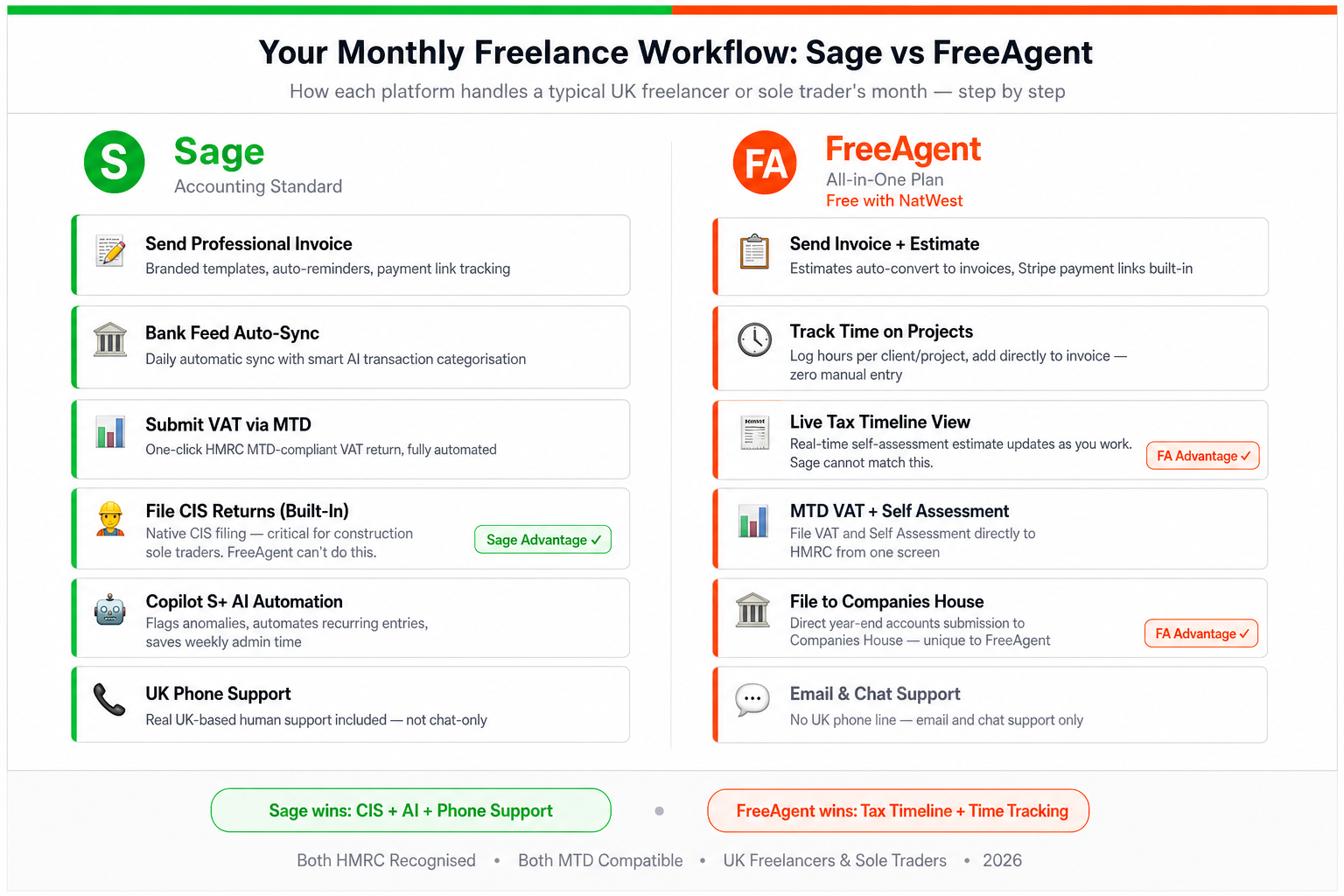
FreeAgent's Tax Timeline is one of the most genuinely useful features in UK self-employed accounting software. It gives you a live, rolling view of what you owe in tax as the year progresses — not after the fact, not when your accountant finishes a year-end set of accounts, but continuously. That matters because most sole traders do not fail on bookkeeping because they cannot raise invoices. They fail because they underestimate their tax bill and use money that was never really theirs.
FreeAgent also lets you file your Self Assessment tax return directly to HMRC from within the software. That is a practical advantage few comparison articles give enough weight to. For a sole trader handling their own compliance, the difference between "software that tracks your numbers" and "software that completes the filing workflow end to end" is significant. It shortens the route from bookkeeping to submission and reduces the number of places errors can creep in.
Sage's answer is automation. Sage Copilot — included even on the free Sole Trader plan — helps prepare and submit quarterly MTD for Income Tax updates with less manual intervention. That makes Sage stronger on passive compliance support than many competitors. But for a sole trader who wants to manage their own annual tax return directly inside the platform, FreeAgent still offers the more complete workflow.
Invoicing
FreeAgent's invoicing is built for freelancers who bill clients for work completed rather than for stock moved or teams managed. The invoice creation process is simple, estimates convert cleanly into invoices, recurring invoices are easy to set up, and automated reminders reduce the need for awkward manual chasing. Payment integrations with Stripe, GoCardless, PayPal, and Tyl by NatWest are all available, which matters for sole traders who want clients to pay quickly without friction.
Sage's invoicing has become more sophisticated because of Copilot. Rather than relying only on rule-based reminders, Sage can draft context-aware invoice follow-ups based on payment behaviour and invoice age. That is more intelligent than standard reminder automation, and for businesses with recurring late-paying clients it has real value. But for the typical freelancer, FreeAgent's invoicing workflow feels more naturally aligned with how one-person service businesses actually bill.
There is also a subtle but important difference in emphasis. FreeAgent was clearly designed around the freelancer who sends quotes, tracks time, invoices a client, and wants that whole chain to feel smooth. Sage can do the same tasks, but the product still feels broader in ambition and less singularly focused on that one-person billing loop.
Time Tracking and Projects
This is one of the clearest dividing lines between the two platforms for freelancers.
FreeAgent includes native time tracking that flows directly into invoicing. You log time against a client or project, convert tracked hours into billable work, and invoice from the same system. For consultants, designers, developers, contractors, and anyone charging by the hour or day, that is not a convenience feature. It is part of the commercial engine of the business.
FreeAgent also allows project-level visibility into income, expenses, and profitability. That means a freelancer can see not just whether the bank balance looks healthy, but whether a specific client relationship is actually making money after costs and time are factored in. Sage has project-related functionality, but its workflow is not as naturally built around the realities of freelance billing. For time-based service businesses, FreeAgent is simply the better-shaped tool.
Bank Reconciliation
Both platforms connect to UK bank accounts through Open Banking and handle transaction imports reliably. For a typical sole trader with a moderate number of monthly transactions, either platform will do the job competently.
FreeAgent's reconciliation experience is clean and accessible. Smart categorisation learns from previous transaction descriptions and becomes more accurate over time, while the dashboard keeps outstanding admin visible without overwhelming the user with accounting language. It is software designed to be understood by business owners, not just accountants.
Sage's edge here is Copilot. It not only helps categorise and reconcile transactions but also flags unusual patterns and anomalies across your accounts. That gives Sage a more proactive quality-control layer, which is useful for sole traders who do their own bookkeeping and want software that spots problems before year-end. FreeAgent is easier to live with day to day; Sage is slightly more watchful in the background.
Expenses and Receipt Capture
Both platforms handle expense tracking well, but FreeAgent's implementation is particularly well tuned to freelance use. The mobile app allows you to record expenses, capture receipts, and match them to transactions while you are away from your desk — which is exactly when most freelancers actually deal with receipts.
FreeAgent's Smart Capture includes automatic extraction and categorisation of receipt and bill data, with up to 10 receipts and bills per month included as standard and an unlimited option available as a paid add-on. For many freelancers that included allowance will be enough. For higher-volume sole traders, the add-on remains inexpensive relative to the time saved. Sage's expense tools are solid, but FreeAgent's mobile-first simplicity is slightly more refined for the self-employed market.
Payroll
Payroll is not usually the first thing a freelancer looks at — until they incorporate, hire someone, or start paying themselves through a limited company. At that point, the comparison becomes more practical.
FreeAgent includes payroll as part of the subscription, which is rare at this end of the market. It can handle PAYE, National Insurance, RTI submissions, and digital payslips without needing a separate payroll product. For a sole trader taking on a first employee or a director running a small limited company payroll, that is genuinely useful. FreeAgent's payroll is not enterprise-grade, but for micro-businesses it is more than adequate.
Sage Standard includes payroll too, but Sage's advantage is scalability. It supports a broader range of workplace pension providers and handles growing payroll complexity better as headcount increases. For one or two people, FreeAgent is enough. For a business that is likely to move beyond that, Sage is the more durable system.
Mobile
FreeAgent has one of the best mobile experiences in UK accounting software for freelancers. Time tracking, invoicing, receipt capture, expense management, and visibility over tax obligations are all accessible from the app in a way that feels genuinely useful rather than token. For freelancers working from client sites, co-working spaces, or while travelling, this matters more than many desktop-first comparison articles acknowledge.
Sage's app is stable and capable, covering invoices, expenses, cash flow, and Copilot access. But the depth of FreeAgent's mobile workflow — particularly when tied to time tracking and project work — makes it the stronger choice for freelancers who want to run admin from their phone as much as from a laptop.
Support
Support quality matters more in freelance accounting software than in enterprise finance tools, because the user often is the finance department.
FreeAgent's support is one of its strongest competitive advantages. Its UK-based support team includes qualified accountants, not just customer service agents following scripts. If a sole trader has a VAT treatment question, a Self Assessment issue, or confusion around allowable expenses, the difference between talking to someone who understands UK tax properly and someone reading from a help article is material.
Sage also offers UK-based support, and its support infrastructure is broader because the product serves a wider customer base. For general troubleshooting, both platforms perform well. But for the freelancer who wants reassurance from people who understand sole trader accounting in a practical UK context, FreeAgent feels more tailored and more human.
Scalability
This is where Sage regains ground. Freelancers often choose software for the business they have now rather than the one they may have in two years. That is understandable, but not always wise.
FreeAgent is outstanding for micro-businesses, but it does have a ceiling. Its strengths are concentration and clarity, not breadth. If the business grows into a small agency, adds employees, requires more complex reporting, needs broader integrations, or begins operating across multiple currencies, FreeAgent can start to feel narrow.
Sage is designed to scale across those stages. A sole trader can begin on the free plan, move into Start, and later upgrade to Standard or Plus without changing platforms. For a freelancer with genuine growth ambitions, Sage is the safer long-term foundation. You give up some of FreeAgent's freelancer-specific polish, but you gain continuity and headroom.
Who Each Platform Is Best For
Choose FreeAgent if
You bank with NatWest, RBS, Ulster Bank, or Mettle and can get the full product free
You are a freelancer who bills by the hour or by project and wants native time tracking
You want to file your own Self Assessment directly from within the software
You want a live Tax Timeline that shows what you owe before deadlines become a problem
You are not an accountant and want jargon-free software with support from qualified UK accountants
Your business is likely to remain a one-person or very small operation
You want a platform built specifically around the daily realities of freelance admin
Choose Sage if
You do not qualify for free FreeAgent and want a strong free sole trader plan
You want AI that actively helps with compliance, anomalies, and invoice chasing
You expect the business to grow beyond sole trader level
You may hire staff and want access to stronger payroll infrastructure as you scale
You need broader reporting and more headroom for future complexity
You want to start free and stay on the same platform as the business matures
You are choosing software not only for now, but for the business you intend to build
The Bottom Line
For most freelancers and sole traders, FreeAgent is the better fit in 2026. It is more purpose-built, more tax-aware, and more naturally aligned with how self-employed people in the UK actually work. Its Tax Timeline, direct Self Assessment filing, integrated time tracking, and accountant-led support make it unusually well matched to one-person businesses.
Sage is not a weak option. In fact, its free Sole Trader plan is one of the most serious offers in the UK market, and Copilot AI gives it a modern automation edge. But Sage feels strongest when viewed as a platform you can grow into. FreeAgent feels strongest when judged on the narrower but more immediate question of what helps a freelancer stay organised, compliant, and paid on time.
If the business is likely to stay small, FreeAgent is the more natural choice. If the business is small now but you expect it to become something larger, Sage is the more strategic one.