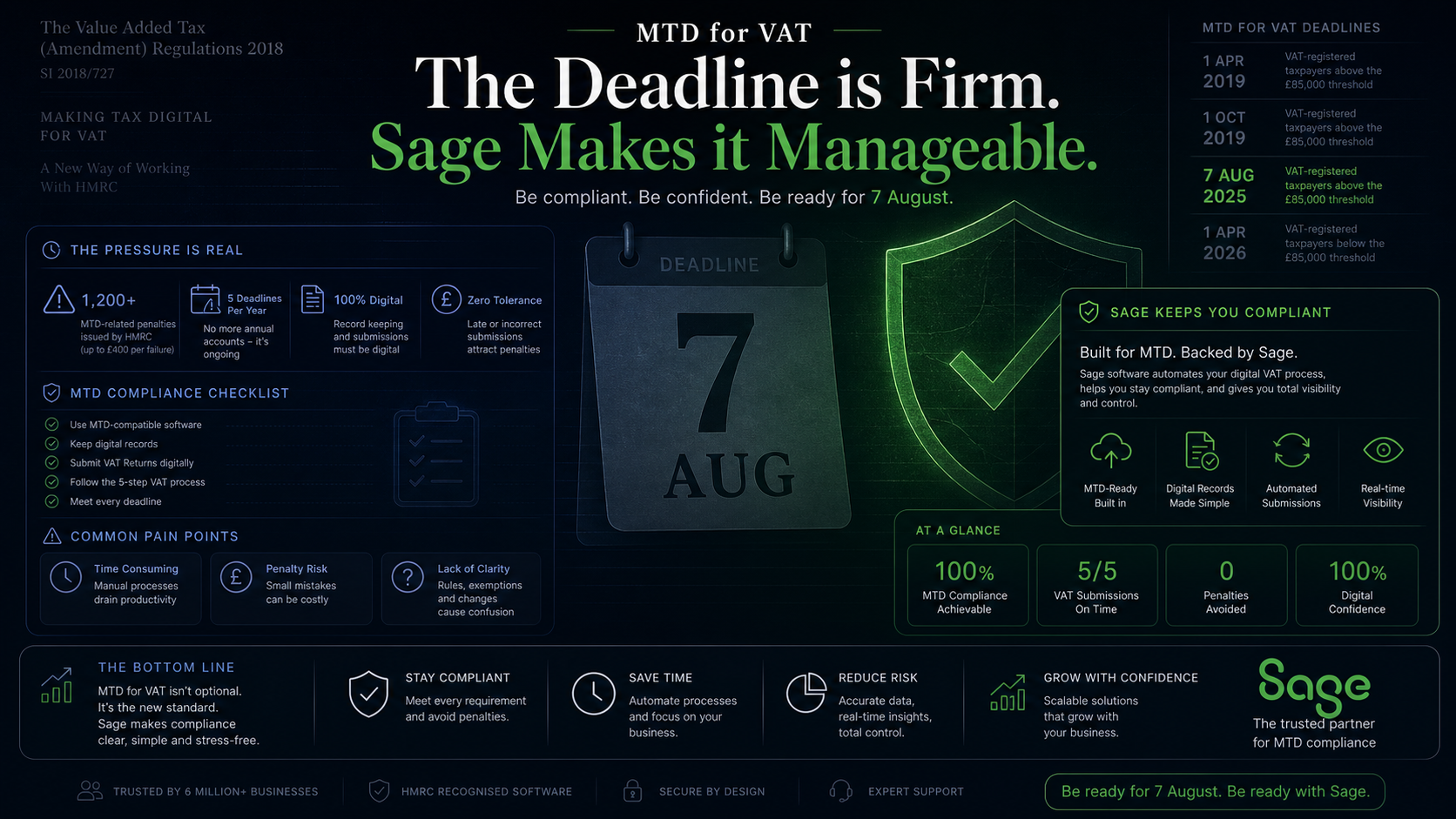
Making Tax Digital is no longer coming. For VAT-registered businesses it has been here since 2022. For sole traders and landlords earning over £50,000 in qualifying income, it became mandatory from 6 April 2026. The compliance window has closed, the penalties are live, and HMRC has added 5,500 new compliance staff specifically to enforce the rules that too many businesses are still treating as optional. This is not a question of whether to get compliant. It is a question of how — and whether the method you choose is reliable enough to stand up to scrutiny if HMRC comes looking.
Sage has been HMRC-recognised compliance software for over four decades. It was live in the MTD for VAT pilot before mandatory rollout. Its MTD for Income Tax quarterly update functionality was built and tested before the April 2026 deadline. As of March 2026, Sage strengthened its accountant-side MTD tools specifically to help practices scale up client compliance without losing accuracy or audit trail integrity. Starting at £18 per month with three months free for new customers, it is also the most cost-accessible fully MTD-compliant platform in the UK market. This article explains the compliance landscape in 2026, where the risks are concentrated, and exactly why Sage is the safest path through it.
The Full MTD Timeline in 2026
Understanding which MTD obligation applies to a given business requires separating three distinct programmes that share a name but operate under different rules, different timelines, and different penalty regimes. Most confusion in the market — and most non-compliance — stems from businesses conflating them or assuming that compliance with one satisfies the requirements of another.
Programme | Who It Applies To | Mandatory Since | Current Status |
|---|---|---|---|
MTD for VAT | All VAT-registered businesses in the UK | April 2019 (above threshold); April 2022 (all VAT registered) | Fully live and enforced. Digital records, digital links, and compatible software submission all mandatory. Penalties active. |
MTD for Income Tax — Phase 1 | Sole traders & landlords with qualifying gross income over £50,000 | 6 April 2026 | Live from this tax year. Quarterly updates, year-end final declaration, digital records all mandatory. Soft-landing on late update penalties in 2026/27 only. |
MTD for Income Tax — Phase 2 | Sole traders & landlords with qualifying gross income over £30,000 | April 2027 | Mandatory from next tax year. Preparation should begin now. |
MTD for Income Tax — Phase 3 | Sole traders & landlords with qualifying gross income over £20,000 | April 2028 | Mandatory in two years. Estimated to bring 90%+ of all self-employed people into scope. |
MTD for Corporation Tax | Limited companies | Not yet confirmed | Pilot expected 2026; mandatory date not yet set. Monitoring required. |
The qualifying income threshold for MTD for Income Tax is the figure that trips up most businesses in Phase 1. It is gross income from self-employment and property combined — not profit, not taxable income, not salary from employment. A business owner with £32,000 from freelance work and £22,000 from a rental property has qualifying income of £54,000 and is in scope from April 2026 even if their total taxable income after expenses and allowances is considerably lower. HMRC assesses the threshold against the 2024/25 tax year income to determine who enters MTD from April 2026.
What MTD for Income Tax Actually Requires
The shift from annual Self Assessment to MTD for Income Tax is a change in operating rhythm as much as a change in compliance tool. The annual return is replaced by a quarterly update process followed by a year-end final declaration. Each of those steps has a specific deadline, specific content requirements, and a specific penalty structure for non-compliance.
Obligation | What It Involves | Deadline | Penalty for Non-Compliance |
|---|---|---|---|
Digital record-keeping | Every income and expense transaction kept digitally, at transaction level, throughout the year | Ongoing — from first day of the obligation | £5–£15 per day for each day records are not maintained digitally |
Q1 Quarterly Update | Summary of income and expenses for 6 April–5 July submitted to HMRC via compatible software | 7 August 2026 | Points-based: 1 point per missed update; 4 points = £200 penalty (soft-landing in 2026/27) |
Q2 Quarterly Update | Summary for 6 July–5 October | 7 November 2026 | As above |
Q3 Quarterly Update | Summary for 6 October 2026–5 January 2027 | 7 February 2027 | As above |
Q4 Quarterly Update | Summary for 6 January–5 April 2027 | 7 May 2027 | As above |
End-of-Period Statement | Confirms and finalises the income and expense figures for each business or property source | 31 January following the tax year (31 Jan 2028 for 2026/27) | Late filing penalties apply as with current Self Assessment |
Final Declaration | Confirms total income from all sources; replaces the annual tax return | 31 January following the tax year | £100 initial penalty; then daily charges; then percentage-based surcharges |
The soft-landing explained
HMRC has confirmed a soft-landing on late quarterly update penalties for the 2026/27 tax year, meaning businesses that miss an update deadline in the first year will not immediately face the £200 threshold penalty. The points accumulate, but the financial penalty is deferred. This grace period covers 2026/27 only. From 2027/28, the full points-based penalty regime applies from day one of any missed deadline. The soft-landing is preparation time, not a permanent concession.
The Three Compliance Requirements Most Businesses Underestimate
Most businesses approaching MTD for the first time focus on the submission deadline — the date by which the quarterly update or VAT return must reach HMRC. That is one of three compliance requirements, and it is arguably the easiest to satisfy. The two that catch businesses out most frequently are the record-keeping standard and the digital link requirement, both of which operate continuously rather than at a specific deadline and both of which carry their own independent penalty exposure.
Transaction-level digital records — HMRC requires individual transaction records, not period summaries. Each sale and purchase must be recorded with its date, amount, VAT rate (for VAT-registered businesses), and supplier or customer name. A monthly total entered into a spreadsheet does not satisfy this requirement. A category total entered into accounting software at the end of the quarter does not satisfy it either. The record must exist at transaction level, retained for six years from the end of the relevant period.
Unbroken digital link — there must be no manual step at any point in the chain from the source transaction record to the HMRC submission. This applies within software as well as between systems. Copying a figure between two tabs in Excel, manually re-typing a total from one system into another, or emailing figures from one person to another for entry into the submission system are all broken digital links. The penalty for a broken link is £5–£15 per day, applied to each day the broken link exists in the record-keeping process.
HMRC-recognised compatible software — submissions must be made through software that is on HMRC’s list of recognised providers for the specific obligation. A tool that is recognised for MTD VAT is not automatically recognised for MTD Income Tax. Bridging software recognised for VAT does not currently have an approved equivalent for MTD Income Tax quarterly updates. The business must use software that is specifically recognised for each obligation it is required to meet.
Why Software Choice Is a Compliance Decision, Not Just a Product Decision
The choice of accounting software for an MTD-affected business is not primarily a decision about features, price, or user experience. It is a compliance decision. The software must satisfy specific HMRC technical requirements for each obligation it covers, maintain the digital link throughout the record-keeping and submission process, and be updated when HMRC changes its specifications — which it does regularly and without extensive notice. A business that chooses software that falls behind on HMRC updates, loses its recognised status, or fails to implement a new requirement on time is non-compliant through no action of its own and with no warning until a penalty notice arrives.
This is where the vendor’s relationship with HMRC matters more than any individual product feature. Sage has worked directly with HMRC on MTD policy and implementation since the programme was designed. Its VAT submission API connection is among the oldest and most tested in the market. Its MTD Income Tax implementation was built from direct HMRC technical specifications before the April 2026 mandatory start, including quarterly update forms, obligation retrieval, submission tracking, full audit trail, and income tax category mapping. In March 2026 — with MTD Income Tax live — Sage published a press release confirming expanded support for accountants managing MTD compliance at scale, including new tools for multi-client quarterly update management. No other UK accounting software provider has the same combination of HMRC integration depth, compliance track record, and active investment in MTD infrastructure in 2026.
Sage’s MTD Compliance Architecture: What It Actually Does
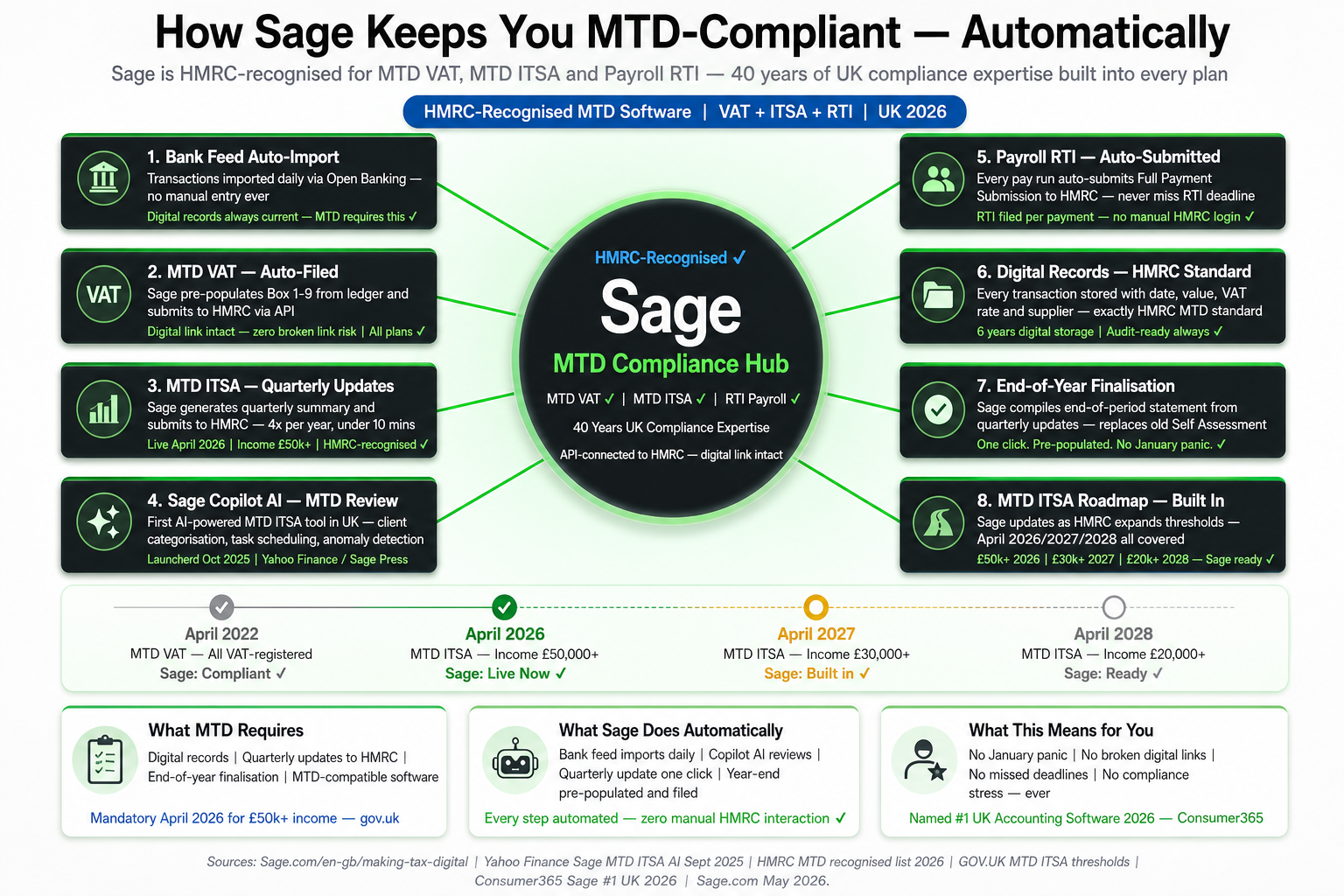
Sage’s MTD compliance is not a submission button added to existing accounting software. It is a compliance architecture that begins at the point of transaction entry and ends with a confirmed submission receipt from HMRC, with an unbroken digital audit trail at every step in between. Understanding what that means in practice explains why businesses using Sage correctly are structurally protected from the most common MTD compliance failures.
Transaction-level digital records from day one — every sale, purchase, and expense entered in Sage is recorded individually with date, amount, supplier or customer, and VAT rate. The record is created at the point of entry, not summarised at period end. Bank feed transactions imported automatically carry the same fields. The six-year retention requirement is met automatically by cloud storage with no manual archiving required.
End-to-end digital link — data flows from transaction record through the accounting ledger to the quarterly update or VAT return via Sage’s internal processes without any manual transfer step. The user reviews and confirms; they do not re-enter data. The digital link is unbroken from source to submission because there is no point at which human data transfer occurs.
Direct HMRC API submission — Sage submits VAT returns and MTD Income Tax quarterly updates directly to HMRC through the official MTD API. The submission is confirmed with a receipt that Sage stores in the audit trail. There is no portal login, no copy-paste of figures, and no third-party submission intermediary required.
Quarterly update forms built into the workflow — for MTD Income Tax users, Sage 50 Accounts v33.1 and above includes built-in quarterly update forms for sole traders. The form pulls income and expense data from the accounts for the relevant period, presents it for review, and submits it directly to HMRC with HMRC integration confirming the obligation has been retrieved and the submission accepted.
Automated obligation retrieval — Sage retrieves the business’s current HMRC obligations directly from the MTD API, so the upcoming deadlines are surfaced within the software rather than requiring the business owner to track them separately.
Full audit trail and reconciliation reports — every submission is recorded with the date, the figures submitted, the HMRC confirmation reference, and the status. If HMRC ever requests evidence of compliance for a given period, the audit trail is available within Sage and exportable in a format suitable for presentation to HMRC or an accountant.
The Pricing: What Compliance Actually Costs with Sage
New customers currently receive three months free before standard pricing applies — a promotional offer valid until 30 June 2026. After the free period, pricing runs month-to-month with no long-term contract, no setup fee, and the ability to upgrade, downgrade, or cancel at any time. All plans include one Sage Copilot AI user, automated bank feeds, and full MTD VAT compliance. MTD Income Tax quarterly update functionality is available in Sage 50 Accounts for sole traders from v33.1 and in Sage Accounting across all tiers.
Product | Plan | Monthly Price (excl. VAT) | MTD Included | Key Features |
|---|---|---|---|---|
Sage Accounting | Start | £18/mo | MTD VAT ✅ | Invoicing, bank feeds, MTD VAT submission, basic reports, Sage Copilot (1 user), no payroll |
Sage Accounting | Standard | £39/mo | MTD VAT ✅ | MTD IT ✅ | Everything in Start plus receipt capture (30 included), cash flow forecasting, AutoEntry integration, additional Copilot users available |
Sage Accounting | Plus | £59/mo | MTD VAT ✅ | MTD IT ✅ | Everything in Standard plus inventory management, multi-currency, 100 receipt captures included, advanced features |
Sage Payroll | 1–5 employees | £8/mo | RTI submissions ✅ | PAYE, NIC, pension auto-enrolment, HMRC RTI, payslips, rate updates automatic |
Sage Payroll | 6–10 employees | £13/mo | RTI submissions ✅ | All payroll features; employee count tier pricing up to 100 employees |
Sage Payroll | 11–15 employees | £19/mo | RTI submissions ✅ | As above |
Sage Payroll | 16–25 employees | £29/mo | RTI submissions ✅ | As above |
Sage Payroll | 26–35 employees | £39/mo | RTI submissions ✅ | As above |
Sage Payroll | 36–50 employees | £55/mo | RTI submissions ✅ | As above |
Sage Payroll | 51–75 employees | £80/mo | RTI submissions ✅ | As above |
Sage Payroll | 76–100 employees | £106/mo | RTI submissions ✅ | As above |
The Accounting Start plan at £18 per month covers MTD for VAT in full — digital records, digital link, and HMRC-recognised submission — for a cost of 60 pence per day. That is less than the minimum daily penalty (£5) for a single day of non-compliant record-keeping. A business that avoids one day of penalty by using Sage Start has already recovered more than a week of the subscription cost. Across a full year, the penalty exposure from non-compliance with MTD for VAT alone — £5–£15 per day for broken digital links, £400 per return for non-compatible software — is multiples of the entire annual Sage subscription.
The SumUp Integration: Free MTD for Income Tax for Sole Traders
In March 2026, SumUp announced the integration of Sage Accounting into its platform specifically to provide MTD for Income Tax compliance for UK sole traders. The SumUp integration embeds Sage’s accounting engine — including quarterly update submission, digital record-keeping, and HMRC API connection — directly within the SumUp platform at no additional charge for SumUp users. This is a significant development because it extends fully compliant MTD for Income Tax functionality to a category of very small traders and micro-businesses for whom even a £18 per month subscription represents a meaningful cost consideration.
The SumUp-Sage integration reflects a broader pattern: Sage’s MTD compliance infrastructure is now the foundation that other fintech platforms are building on top of. That does not happen with software that has uncertain compliance status or a shallow HMRC API integration. It happens because Sage’s MTD implementation is recognised as the most reliable in the UK market — reliable enough that a major payment platform chose to embed it rather than build its own. For sole traders and micro-businesses not using SumUp, the same compliance infrastructure is available directly through Sage Accounting from £18 per month.
What Being on the Wrong Software Looks Like in Practice
Non-compliant software or process
VAT return figures extracted from accounting system, copied into a spreadsheet, then pasted into an online submission — broken digital link at every transfer step
Quarterly MTD Income Tax updates not submitted because the software cannot connect to HMRC’s MTD Income Tax API
Monthly totals recorded in Excel rather than individual transactions — does not meet the transaction-level record-keeping requirement
Software not updated to reflect HMRC’s specification changes — submission rejected or accepted with errors that surface later
No submission confirmation record stored — cannot evidence compliance if HMRC opens a compliance check
Business owner unaware that their bookkeeper’s process involves a manual re-entry step — non-compliant without knowing it
Bridging software used for VAT incorrectly assumed to cover MTD Income Tax — no quarterly updates submitted; obligation missed entirely
Sage Accounting in 2026
VAT return generated from transaction data within Sage; submitted directly to HMRC via MTD API — no manual transfer at any point
Quarterly MTD Income Tax updates submitted directly from Sage 50 Accounts (v33.1+) or Sage Accounting; obligation retrieved from HMRC automatically
Every transaction recorded individually at point of entry via manual input, bank feed, or AutoEntry receipt capture — transaction-level records maintained automatically
Sage HMRC rate and specification updates applied before effective date — compliance maintained without business owner action
Full submission audit trail stored in Sage: date, figures, HMRC confirmation reference, status — available for instant production in any compliance check
Business owner, bookkeeper, and accountant all work in the same Sage environment — no re-entry steps between them
Separate recognised compliance for MTD VAT and MTD Income Tax both built into the same platform — one system, all obligations covered
The 40 Years of HMRC Relationship That Cannot Be Replicated
Sage has been working directly with HMRC on digital tax compliance since before Making Tax Digital existed as a programme. That relationship means Sage receives early access to HMRC technical specifications, participates in pilot programmes before mandatory rollout, and has the institutional knowledge to implement changes correctly the first time rather than correcting errors after live deployment. When HMRC published the MTD for Income Tax API specifications, Sage was among the first providers to build against them. When HMRC updated those specifications during the development period, Sage was already in communication about the changes.
That track record is not visible in a feature comparison table. It is visible in the absence of the problems that affect businesses on less established platforms: submission rejections from outdated API connections, rate calculation errors from missed specification updates, compliance check failures from incorrect record-keeping formats. For a business that needs to stay compliant through a period of rapid regulatory change — and 2026 is that period for UK sole traders and landlords — the vendor’s depth of HMRC relationship is a more important variable than any individual feature on the pricing page.
The Bottom Line
Making Tax Digital is here. For VAT-registered businesses it has been mandatory since 2022. For sole traders and landlords above £50,000 in qualifying income it is mandatory now, in this tax year, with the first quarterly update deadline of 7 August 2026 already approaching. The penalties for non-compliance are specific, automatic, and actively enforced by an HMRC compliance team that has added 5,500 new staff to pursue the £11.9 billion VAT gap and the growing income tax compliance deficit.
Sage is the safest way to stay compliant in that environment for three reasons that compound each other. First, it is the most deeply integrated with HMRC’s MTD infrastructure of any accounting software in the UK market — 40 years of compliance history and direct API connections for both VAT and Income Tax that have been tested at scale before every mandatory deadline. Second, it builds compliance into the daily workflow rather than requiring a separate compliance step at period end — the transaction is the record, the record is the digital link, and the digital link is the submission. Third, it costs £18 per month with three months free — less than a single day’s minimum penalty for non-compliant record-keeping, and a fraction of what the first HMRC compliance check would cost to resolve without a clean, complete, Sage-generated audit trail to present.
The question in 2026 is not whether MTD applies to your business. It is whether the system you are using will keep you on the right side of it quietly, automatically, and reliably — or whether you will discover the gap when HMRC tells you it exists.