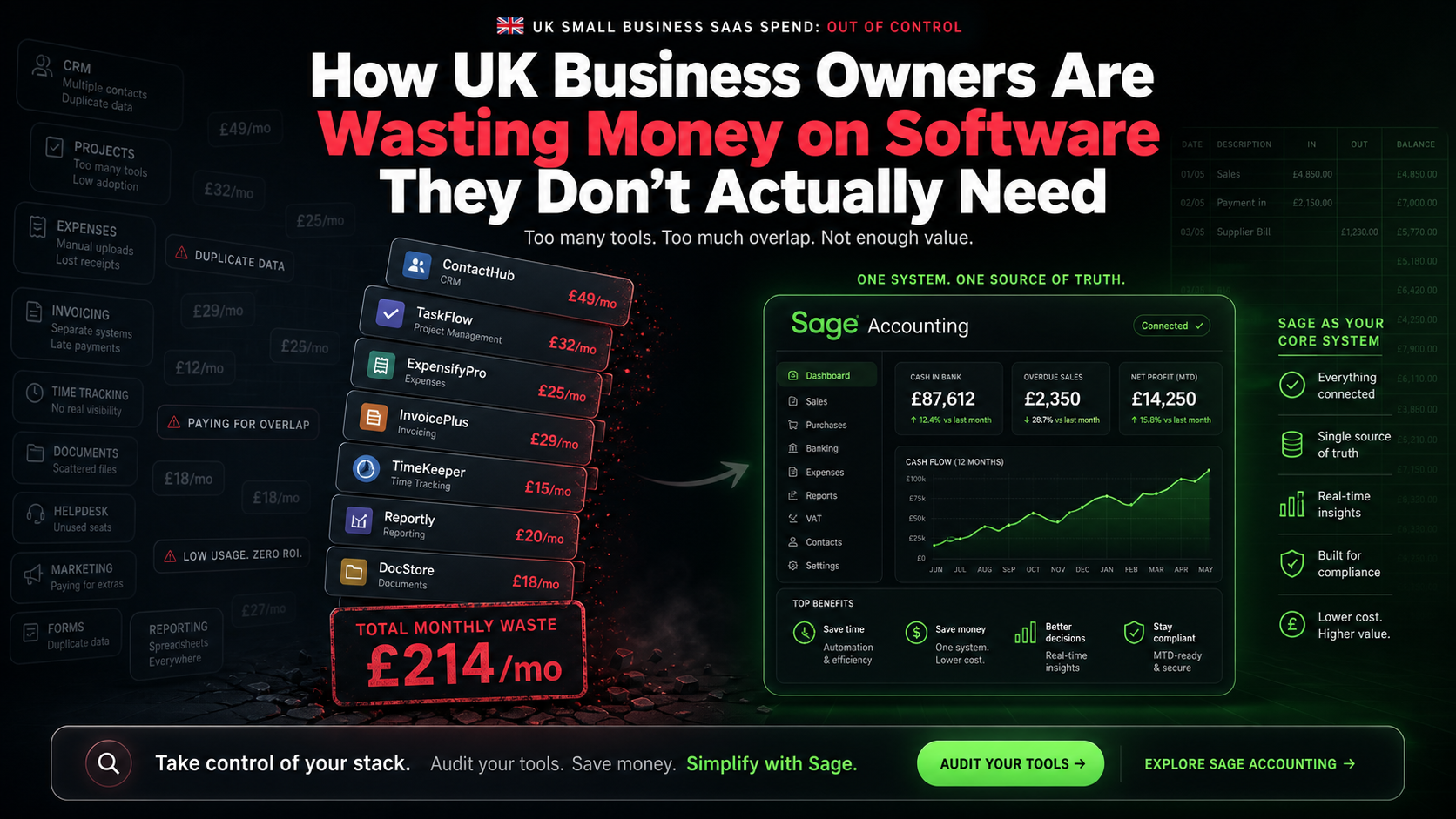
There is a particular type of business expense that barely registers as a problem because no single item is large enough to cause alarm. It is not the £20,000 equipment purchase or the £8,000 accountant bill. It is the quiet accumulation of monthly software subscriptions — each one between £10 and £80, each one signed up for with good intentions, most of them used partially, some of them forgotten entirely — that adds up to a number most business owners have never actually calculated. When UK businesses do calculate it, the result is consistently larger than expected and consistently difficult to justify.
Fasthosts research published in April 2026 found that UK SMEs could be wasting up to £10,000 a year on unused SaaS tools, with nearly 40% of workplace software going unused. Capterra’s 2026 Software Buying Trends Report found that only 27% of UK software buyers were fully satisfied with their most recent purchase, with 52% experiencing regret. UK enterprises now regret approximately 1 in 5 software purchases, contributing to an estimated £32 billion in excess software spend across UK businesses. The problem is not that UK business owners are careless with money. It is that the way software is sold, adopted, and renewed is designed to make the cost invisible and the exit difficult. This article names the specific patterns through which the waste happens — and explains why Sage’s consolidated approach addresses the root cause rather than just the symptoms.
The Scale of the Problem in Numbers
£10,000 average annual waste on unused SaaS tools per UK SME — Fasthosts research, April 2026
40% of workplace software goes unused — Fasthosts, corroborated by Zylo and Productiv research on SaaS utilisation
52% of UK software buyers experienced regret on their most recent purchase — Capterra 2026 Software Buying Trends Report
£33.9bn wasted by UK SMEs annually on administrative tasks that could be automated — productivity research cited by Digital Shouts
These figures come from separate research bodies using different methodologies, which makes the consistency of the direction more significant than any individual number. Whether the measure is unused licences, buyer regret, wasted admin time, or excess SaaS spend, the conclusion is the same: UK businesses are systematically paying for software capability they are not using, and the cost compounds quietly over months and years. The £10,000 annual waste figure from Fasthosts is a per-business average for SMEs — not a large enterprise figure. For a business with 15 employees and annual turnover of £600,000, £10,000 in software waste represents 1.7% of revenue spent on tools that are not producing value. At any reasonable profit margin, that is a material number.
How the Software Stack Gets Expensive: The Five Patterns
The path from a lean, functional set of business tools to an expensive, overlapping tangle of subscriptions follows predictable patterns. Understanding the patterns is the first step to auditing your own stack honestly, because none of them feel like mistakes at the time they happen.
Pattern 1: Building a Stack Instead of a System
The most common pattern among UK small businesses is assembling a collection of separate tools that each solve one problem without solving the underlying inefficiency. A typical example from Fasthosts’ research illustrates it clearly: a 15-person business running Slack for communication, Asana for project management, HubSpot for CRM, SEMrush for SEO, Hootsuite for social media, and Xero for accounting — with 10 to 15 subscriptions priced between £10 and £50 per user per month — is spending between £27,000 and £54,000 annually on software. Removing just two of those tools saves up to £10,000 per year. But the problem is not usually that two tools are obviously redundant. It is that none of the tools talk to each other, so the data from each one needs to be manually transferred or re-entered in the others.
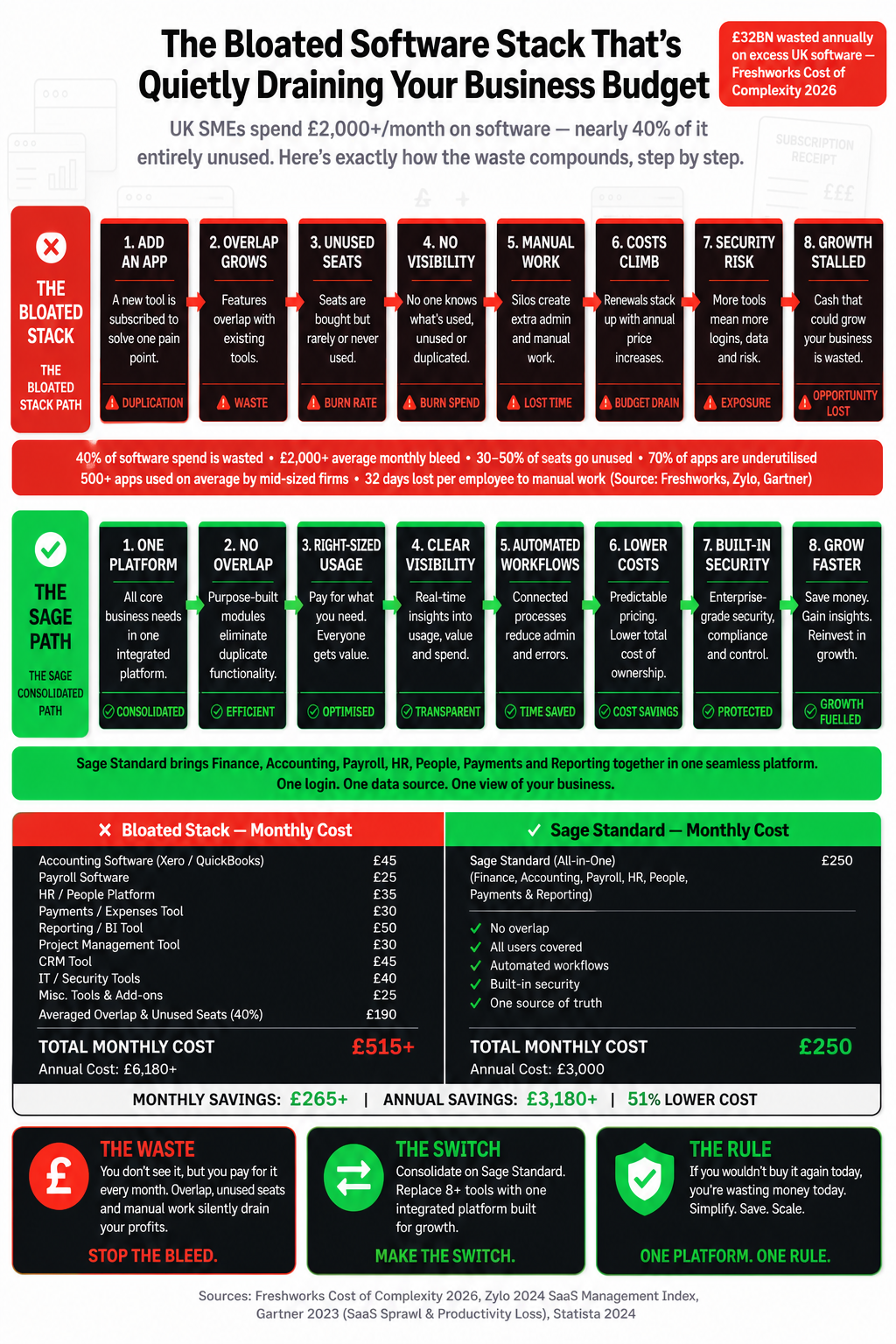
European Business Review research found that employees in UK businesses now manage nearly 40 different applications on average, losing approximately 51 minutes every week just switching between them. That is not a productivity enhancement. It is a productivity tax. The mid-sized businesses that recognised this cut their application portfolios by 29% in 2025. The businesses that have not recognised it are still paying the switching cost every day, in addition to the subscription cost every month.
Pattern 2: Paying for Features You Will Never Use
Software vendors sell on feature count. The more features listed on the pricing page, the more justified the price seems. But features are only worth paying for if they are used, and most business owners who sign up to a mid-tier or enterprise plan for a platform do so because of three or four features they intend to use — and then never explore the remaining twenty. Capterra found that 92% of UK buyers who regretted a software purchase experienced implementation issues as the primary driver of that regret. Implementation failure means the features that justified the purchase were never adopted, which means the business paid enterprise pricing for basic usage.
The pattern is particularly pronounced in accounting software. A sole trader who signs up to a full accounting platform designed for growing businesses with employees, inventory management, multi-currency transactions, and advanced reporting is paying for capability that will never be used. The same compliance outcome — MTD for VAT, digital records, Self Assessment preparation — is available from a product built specifically for that business type, at a fraction of the cost. The waste is not deliberate. It is the consequence of choosing software based on brand recognition or a colleague’s recommendation rather than a honest assessment of what the business actually needs.
Pattern 3: The Auto-Renewal Trap
SaaS pricing is designed around the subscription model for one reason above all others: churn reduction. Annual commitments are cheaper than monthly. Annual commitments also require active cancellation at renewal rather than active continuation — which means businesses that have stopped using a tool continue paying for it unless someone specifically acts to cancel. Fasthosts found that 40% of organisations had at least one redundant SaaS tool in place during 2024. The IT Brief analysis of the same data notes that 39% of employees do not use the software their companies provide. The subscriptions continue. The direct debits process. Nobody notices until someone runs the annual software audit that most businesses never actually run.
The quarterly direct debit audit
The fastest way to find software waste in a UK small business is to open the last three months of bank statements and highlight every recurring payment between £5 and £200. List each one, the tool it pays for, and the last time someone in the business actively used that tool for something that produced value. In a business with 10 or more subscriptions, it is typical to find two or three that no one can clearly articulate the current purpose of. The annual cost of those tools is the starting point for a software rationalisation conversation.
Pattern 4: The ChatGPT-as-Accountant Problem
A more recent pattern, specific to 2025 and 2026, is the belief that general-purpose AI tools can replace specialist financial software. Dext commissioned research in December 2025 that surveyed 500 UK accountants and bookkeepers. Their findings are stark: 50% of UK accountants are aware of businesses that have suffered direct financial losses from incorrect AI-generated financial advice, including overpayments, missed tax allowances, penalties, fines, and compliance failures. The most common errors include incorrect interpretation of business expenses (46%), incorrectly claiming or charging VAT (41%), and payroll errors (34%). A further 33% of accountants warned of a higher risk of insolvency or business failure for businesses over-relying on general-purpose AI for financial decisions.
The appeal is understandable: a ChatGPT subscription costs less than accounting software, and it answers questions immediately in plain English. The problem is that it has no access to HMRC’s real-time rules, no integration with the business’s actual records, no ability to file returns, and no accountability when it gives wrong advice. Accountants surveyed by Dext estimate they spend up to 10 hours per month correcting errors caused by AI-generated financial advice. At typical accountant rates, that correction cost is passed on to the business — making the “cheap” AI tool considerably more expensive than the specialist software it replaced.
Pattern 5: The 20% Usage Problem
Blackstone Coopers’ research into business software adoption found that businesses regularly use as little as 20% of the capability of the software they purchase. That is not a problem with the software. It is a problem with the selection and implementation process. A tool that is 20% used is 80% waste — and in a subscription model, 80% waste means 80% of the monthly fee is producing no return. UK businesses collectively waste £33.9 billion annually on administrative tasks that current technology could automate, according to research cited by Digital Shouts. The automation tools exist. They are frequently already included in software the business is paying for. They are simply not being used, because the software was never fully implemented and the features were never discovered.
The Typical UK Small Business Software Stack and Its Real Cost
Tool Category | Common Products Used | Typical Monthly Cost | Annual Cost | What % Is Actually Used |
|---|---|---|---|---|
Accounting | Xero, QuickBooks, FreshBooks | £14 – £45/mo | £168 – £540/yr | 30–50% of features used by most small businesses |
Invoicing (separate) | Invoice Ninja, Zoho Invoice, Wave | £0 – £20/mo | £0 – £240/yr | Fully used — but redundant if accounting software includes invoicing |
Payroll (separate) | Brightpay, Moneysoft, Staffology | £10 – £30/mo | £120 – £360/yr | Core payroll used; integration with accounts rarely configured |
Expense management | Expensify, Dext, Hubdoc | £8 – £30/mo | £96 – £360/yr | Redundant if accounting software includes receipt capture |
MTD bridging (VAT) | BTC Software, VAT Bridger, DataDear | £10 – £20/mo | £120 – £240/yr | 100% used — but entirely redundant if accounting software includes native MTD VAT |
Cash flow forecasting | Float, Fluidly, Futrli | £25 – £60/mo | £300 – £720/yr | Redundant if accounting software includes Copilot cash flow alerts and forecasting |
AI financial advice | ChatGPT Plus, Claude, Copilot for Microsoft 365 | £16 – £25/mo | £192 – £300/yr | Producing errors in 50% of cases per accountant research — net negative value |
Typical stack total | 6–8 separate tools | £83 – £230/mo | £996 – £2,760/yr | Multiple redundancies; no tools share data natively |
The right-hand column is the most important. Several of those tool categories are redundant if the accounting platform the business is already paying for includes the same capability natively. A business paying separately for bridging software, receipt capture, cash flow forecasting, and invoicing — while also paying for accounting software that includes all four — is paying twice for the same capability. The tools do not overlap cleanly enough for either to replace the other, but they produce exactly the kind of double-handling and manual re-entry that generates errors and consumes admin time. The business pays for the tools. Then it pays again in staff time for the workarounds the tools’ incompatibility creates.
Why Disconnected Tools Cost More Than Their Licence Fees
The direct subscription cost is the number most business owners focus on when auditing software spend. It is not the most significant number. European Business Review research on UK SMEs found that a distributor running orders through three disconnected platforms burns 5 to 10 staff hours per week on manual data transfers alone — roughly £15,000 to £30,000 a year in wasted salary costs. The research also found that hidden inefficiencies from disconnected systems drain 3 to 6% of revenue in mid-sized firms. Those are not small numbers, and they are entirely invisible on the surface of a software audit that only looks at licence fees.
The mechanism is straightforward. When two systems do not share data, someone has to manually transfer information between them. That transfer takes time, introduces the possibility of error at every manual entry point, and creates a version control problem — if the same data exists in two places and one is updated without the other, the business is now operating from inconsistent records. For a UK small business managing invoices in one system, expenses in another, payroll in a third, and bank reconciliation in a fourth, the time cost of maintaining consistency across those four systems is a constant background tax on every person who touches any of them.
The switching cost that never appears on an invoice
Employees in businesses running 40 or more applications lose an average of 51 minutes per week switching between tools, according to research cited by the European Business Review. For a 5-person business where all five employees touch some of the software stack, that is 4 hours and 15 minutes of collective time lost every week to application switching alone — not to using the tools, just to switching between them. At an average loaded employment cost of £25 per hour, that is approximately £5,525 per year in lost productivity from context-switching alone, before any consideration of errors, re-entry time, or training costs.
What a Consolidated Platform Actually Changes
The alternative to a stack of disconnected tools is a platform where the capabilities a small business needs exist in a single environment, connected to the same data, without requiring manual transfers between systems or bridging software to fill integration gaps. That is the principle behind Sage Accounting — and the reason it is structured the way it is.
Disconnected stack approach
Accounting software (no receipt capture) + separate Dext subscription for expense capture: two monthly fees, two logins, manual sync between them
Accounting software (no MTD VAT) + bridging software: two monthly fees, spreadsheet maintained in parallel, manual transfer to bridge tool each quarter
Accounting software (no payroll) + separate payroll product: two monthly fees, payroll journal manually entered into accounts after each pay run, bank reconciliation done twice
Accounting software (no forecasting) + Float or Futrli: two monthly fees, data exported from accounts and re-imported into forecasting tool, always one step behind actual records
Accounting software (no AI) + ChatGPT for financial questions: advice untethered from actual records, errors introduced into accounts, accountant correction time billed back to business
Total typical cost: £83 to £230 per month across 6 to 8 tools; no single source of truth; multiple reconciliation tasks required continuously
Sage consolidated approach
Accounting Standard at £39/mo includes receipt capture (30/mo), MTD VAT, invoicing, bank feeds, cash flow forecasting, and Copilot AI — one login, one data set, zero manual transfers between modules
Add Sage Payroll Essentials at £10/mo for up to 5 employees: payroll journals post to accounts automatically after each pay run; no manual entry; bank reconciliation reflects payroll in real time
Copilot AI included in the £39 plan: trained on 40 years of UK business data, connected directly to actual records, produces no advice errors of the type generated by general-purpose AI tools
MTD for VAT returns prepared and submitted within the same platform where invoices and expenses are recorded: no bridging software, no broken digital links, no compliance gap
Cash flow projections generated by Copilot from live transaction data: no export, no import, no version control problem, always current
Total cost: £49/mo (Accounting Standard + Payroll Essentials); single source of truth; zero inter-tool reconciliation required
The Real Cost Comparison
Capability Needed | Disconnected Stack Cost | Sage Accounting Standard + Payroll | Annual Saving |
|---|---|---|---|
Accounting + bank feeds | £14 – £45/mo (Xero / QB) | £49/mo | £564 – £2,172/yr saved on licences alone |
MTD bridging (VAT) | £10 – £20/mo extra | ||
Receipt / expense capture | £8 – £30/mo extra (Dext / Hubdoc) | ||
Cash flow forecasting | £25 – £60/mo extra (Float / Futrli) | ||
Payroll (up to 5 employees) | £10 – £30/mo extra (BrightPay / Staffology) | ||
AI-powered financial assistant | £16 – £25/mo extra (ChatGPT / Microsoft Copilot) — plus accountant error correction cost |
The annual licence saving of £564 to £2,172 is the direct comparison between paying for each capability separately and paying for them together through Sage Accounting Standard and Payroll Essentials. It does not include the admin time saved by eliminating manual inter-tool data transfers, the accountant correction time saved by not using general-purpose AI for financial advice, the penalty exposure reduced by having MTD-compliant VAT filing native to the accounting platform, or the time saved by Copilot’s automation of invoice chasing, reporting, and anomaly detection. When those secondary savings are included, the true cost advantage of the consolidated approach is considerably larger than the licence comparison alone suggests.
The Software Audit: How to Know If You Have a Problem
The fastest way for a UK small business to assess whether it is wasting money on software is to run a five-question audit against its current stack. This does not require an IT specialist or a management consultant. It requires an honest conversation between the business owner and the list of recurring software payments on the last three months of bank statements.
What does this tool do that our accounting software does not already do? If the answer is “nothing, actually” or “I’m not sure,” the tool is a candidate for cancellation. Check your accounting software’s feature list before renewing any adjacent subscription.
When did someone in this business last actively use this tool for something that produced value? If the answer is more than 60 days ago, the tool has failed adoption. Paying for a tool that is not being used is not an investment in future capability. It is a recurring loss.
Does this tool share data directly with our accounting software, or does someone have to manually transfer information between them? If the answer is manual transfer, the tool is generating hidden admin cost in addition to its licence fee. The true cost is the subscription plus the time cost of the transfer process.
Do we use more than 30% of the features we are paying for in this tool? If not, is there a lower tier or a more focused tool that covers only the features you are actually using, at a lower price?
Is this tool solving a problem that our current platform already solves, and we simply have not set it up yet? A significant proportion of software waste comes not from genuinely redundant tools but from unused capabilities within tools the business is already paying for. Receipt capture, cash flow forecasting, and automated payment reminders are features included in Sage Accounting Standard that many subscribers have never activated — while simultaneously paying for separate tools that do the same thing.
Why Sage Is the Consolidation Platform That Makes Sense
The case for Sage as the answer to software sprawl is not a branding claim. It is a structural one. Sage Accounting Standard at £39 per month includes, in a single connected environment: MTD for VAT compliance, MTD for Income Tax quarterly update submission, professional invoicing with automated payment reminders via Copilot, bank feeds with automatic transaction import, receipt capture for 30 documents per month, cash flow forecasting, anomaly detection, and Sage Copilot AI trained on 40 years of UK business accounting data. Adding Sage Payroll Essentials at £10 per month covers PAYE, NIC, RTI submissions to HMRC, auto-enrolment, and payroll journal posting directly into the accounts — for up to 5 employees.
The total platform cost is £49 per month for a UK small business needing accounting, MTD compliance, invoicing, expenses, cash flow visibility, AI-powered automation, and payroll for up to 5 employees. Against the typical disconnected stack cost of £83 to £230 per month for the same capabilities delivered through 6 to 8 separate tools — none of which share data without manual effort — the Sage consolidated approach saves between £34 and £181 per month on licences before any other efficiency is counted. For a business on the lower end of the stack cost range, that is a saving of £408 per year. For a business on the upper end, it is a saving of £2,172 per year. Both figures assume the current three months free offer is taken, which defers the first £147 of cost entirely.
The broader point is not that every UK small business is using exactly the tools in the comparison above. It is that the pattern of building a software stack by adding tools for each new problem — rather than choosing a platform that solves multiple problems in a connected way — is the mechanism that produces the £10,000 annual software waste figure that Fasthosts measured across UK SMEs. The individual tools are rarely wrong choices in isolation. The problem is the accumulation, the disconnection, the manual overhead, and the quiet auto-renewal that keeps the cost growing long after the justification for each tool has expired. Sage’s consolidated design is the architectural answer to that problem — not because it is the only platform with multiple features, but because it is the one built specifically around the compliance, automation, and reporting needs of UK small businesses, at a price that makes consolidation a financial decision rather than a compromise.