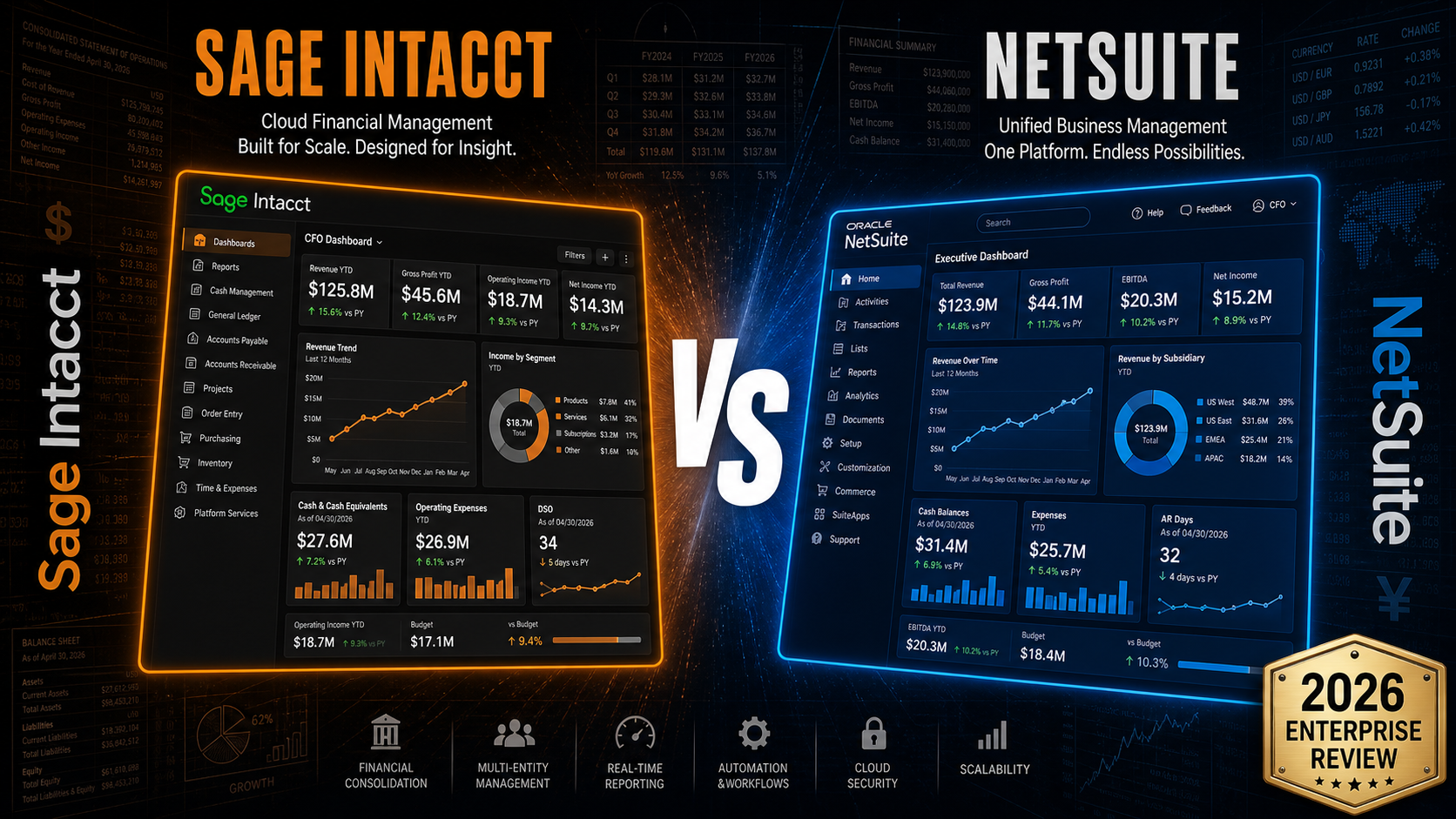
There is a point in the growth of most UK businesses when the accounting software that got them through the early years stops doing the job. The month-end close takes too long. Consolidating multiple entities means exporting everything to spreadsheets and reconciling manually. The management accounts the board is asking for take three days to produce instead of an afternoon. The finance function has become a bottleneck rather than a strategic asset. That is the moment a business starts looking seriously at enterprise-grade financial management systems — and the two names that come up most consistently in that conversation are Sage Intacct and Oracle NetSuite.
Both are cloud-based, both are used extensively across the UK market, and both are capable of handling the financial complexity that growing mid-market businesses generate. But they are not the same kind of product, they are not suited to the same businesses, and choosing between them on the basis of feature lists alone is likely to produce the wrong outcome. This comparison cuts through the standard positioning to explain what each platform actually is, where each genuinely excels, and what the decision looks like in practice for a UK business evaluating both.
The Fundamental Distinction
Every comparison between Sage Intacct and NetSuite has to start here, because the rest of the analysis flows directly from it. Sage Intacct is a best-in-class financial management system. NetSuite is a comprehensive enterprise resource planning platform. That is not a subtle difference in emphasis — it is a structural difference in what the software was built to do and what kind of organisation it is designed to serve.
Sage Intacct was built for finance professionals. Its design philosophy is to make the finance function as capable, automated, and self-sufficient as possible, without requiring IT involvement to run standard reporting or period-end processes. It handles general ledger, accounts payable and receivable, cash management, financial consolidation, project accounting, revenue recognition, and multi-entity reporting at a depth that most comparable systems do not match. What it does not do natively — inventory management at scale, CRM, manufacturing operations, warehouse management — it is designed to integrate with from best-in-class third-party systems via an open API architecture.
NetSuite was built as an ERP suite. It handles finance, but it also handles CRM, inventory, order management, supply chain, manufacturing, e-commerce, and HR — all within a single platform. The advantage of that approach is cohesion: data flows across departments in real time without integration dependencies. The trade-off is that a platform designed to cover everything for a broad range of businesses cannot go as deep in any single domain as a platform built for that domain alone. For product-based businesses that need operational and financial data in the same system, NetSuite is often the right answer. For finance-focused or service-based businesses that need best-in-class accounting capability and are comfortable connecting other tools via integration, Sage Intacct is frequently the stronger fit.
Who Each Platform Is Built For
Understanding the intended user of each platform matters more in this comparison than it does when choosing between two small-business accounting tools. The decision affects not just the finance team but potentially the entire organisation's technology infrastructure.
Sage Intacct is used most successfully by organisations where the finance function operates at the centre of the business. Professional services firms — accountancies, consultancies, law firms, recruitment businesses — find it particularly well suited because it handles project-based billing, multi-entity consolidation, and the kind of dimensional reporting that service businesses need across clients, projects, departments, and locations. SaaS businesses and subscription-based companies are also natural Intacct users, because its revenue recognition capabilities handle the complexity of ASC 606 and IFRS 15 compliance more gracefully than most alternatives at its price point. Non-profit organisations — including many UK charities and housing associations — use Intacct for its fund accounting capabilities and grant management reporting.
NetSuite is used most successfully by product-based businesses — manufacturers, distributors, wholesalers, and multi-channel retailers — where the connection between operational and financial data is operationally important rather than just useful to have. A manufacturer that needs to understand the relationship between production costs, inventory valuation, order fulfilment, and financial performance in a single system without stitching together multiple platforms will find NetSuite more naturally suited to that need. Fast-growing businesses that are scaling internationally and need a single system to handle multi-currency, multi-subsidiary, and multi-country tax requirements across operational and financial functions also tend to find NetSuite a more complete solution than Intacct for those specific requirements.
The profile of businesses choosing Sage Intacct and NetSuite in the UK reflects these patterns. Where Intacct tends to win: professional services, financial services, non-profits, SaaS and subscription businesses, and finance-first organisations that want accounting depth and integration flexibility. Where NetSuite tends to win: manufacturing, distribution, retail, e-commerce, and businesses that want a single operational system across functions without managing integration complexity.
Financial Management Depth
In the domain both platforms share — financial management — Sage Intacct has a genuine and well-documented advantage in depth and configurability for finance teams.
Sage Intacct's general ledger uses a multi-dimensional structure rather than a traditional chart of accounts approach. Instead of building an increasingly complex account string to capture different reporting dimensions — department, location, project, fund, class — Intacct lets finance teams tag transactions with up to eight user-defined dimensions and then slice reporting across any combination of those dimensions without duplicating accounts. This architecture fundamentally changes what period-end reporting looks like: instead of building bespoke reports for every combination of entities and dimensions, the finance team sets up dimensions once and gets any view the business needs without IT involvement. Intacct's multi-dimensional reporting structure is consistently cited by finance teams as the feature that has the most transformative impact on reporting workload.
Multi-entity consolidation is another area where Intacct is structurally stronger for many mid-market UK businesses. Businesses operating multiple legal entities — including group structures, joint ventures, international subsidiaries, or businesses with separate entities for different service lines — can consolidate across entities with inter-company eliminations handled automatically, different base currencies supported natively, and full audit trails maintained at both entity and group level. Producing consolidated group accounts in Intacct, for organisations built on its architecture, typically takes a fraction of the time it takes in a system that was not designed with multi-entity consolidation as a core capability.
NetSuite's financial management is capable and covers the essentials well — general ledger, accounts payable, accounts receivable, cash management, and financial reporting are all solidly implemented. Its multi-entity capabilities have improved significantly over the years and handle most mid-market multi-subsidiary structures effectively. Where finance teams using NetSuite more commonly report friction is in the configuration required to get the same flexibility of dimensional reporting that Intacct delivers out of the box, and in the involvement of technical resources or consultants that complex reporting customisation can require. For businesses that primarily need operational data across functions — and for which financial reporting is important but not the defining challenge — that trade-off is often acceptable. For businesses where the finance function is the most sophisticated user of the system, it is a more significant constraint.
Accounts Payable and Receivable Automation
Both platforms automate core AP and AR workflows, but the depth of that automation differs in ways that matter operationally for mid-market finance teams.
Sage Intacct's accounts payable module handles invoice approval workflows, payment scheduling, and audit tracking with enough configurability to match most internal control structures without custom development. AP automation connects to purchasing workflows and supports multi-level approval routing based on invoice value, entity, department, or vendor category. The platform integrates directly with dedicated AP automation tools — including Yooz, AvidXchange, and others — via pre-built connectors, which allows businesses that need high-volume invoice processing to add specialist functionality without rebuilding the core financial system.
Sage Intacct's accounts receivable module supports flexible billing models including project-based, milestone, usage-based, and recurring billing. Days Sales Outstanding, outstanding balances, and aging reports are available in real time rather than as scheduled outputs. For professional services businesses with complex billing arrangements — time and materials projects alongside fixed-fee retainers alongside milestone-based engagements — the billing flexibility is a practical advantage over more rigid billing structures.
NetSuite's AP and AR are well-integrated with the broader operational system. The strength of NetSuite's AP is in its connection to procurement and inventory — for a manufacturing business where accounts payable is downstream of purchase orders, goods receipts, and inventory valuations, that connected workflow is operationally more useful than a standalone AP module. NetSuite AR supports recurring billing and revenue recognition, and its integration with the CRM module means sales-to-invoice workflows can be managed within the platform. The finance-specific depth of Intacct's AP and AR — particularly the billing flexibility and the dimensional reporting on outstanding balances — gives Intacct an edge for service-based businesses, while NetSuite's operational integration gives it the advantage for product-based businesses.
Reporting and Business Intelligence
Reporting is frequently the dimension that tips a decision between these two platforms, because it is the area where finance teams feel the pain of their current system most acutely and the area where both Intacct and NetSuite have invested most heavily in differentiation.
Sage Intacct's reporting is self-service by design. Finance teams can build custom reports, dashboards, and drill-down analyses without involving IT or a technical consultant. The multi-dimensional structure of the general ledger means that a report filtered by entity, department, project, and location — or any combination of those dimensions — does not require a custom field or a configuration change. It is available by design because the data was captured dimensionally when transactions were posted. This architecture is what allows Intacct to offer the much-cited claim that businesses can reduce their period-end close time by up to 70% — the time savings are real for businesses where manual reporting consolidation was the bottleneck, and the architecture is what enables them.
Intacct also offers Sage Intacct Budgeting and Planning as an add-on, which connects directly to the core financial data and allows finance teams to build driver-based models, run scenario analysis, and produce budget-versus-actual reports without exporting to Excel. For a growing business that has outgrown spreadsheet-based planning but is not yet at the scale where a full enterprise planning platform like Anaplan is justified, the integrated planning module is a practical and cost-effective addition.
NetSuite's reporting is capable across the operational breadth of the platform. Real-time dashboards pull in data from finance, inventory, CRM, and operations simultaneously, which is genuinely valuable for businesses where operational and financial performance are closely connected and the CFO and COO both need visibility into the same data set. SuiteAnalytics, NetSuite's built-in analytics tool, offers workbook-style data exploration and custom reporting. The limitation, noted consistently in the practice of NetSuite users, is that more complex custom reports often require involvement from a technical user or consultant rather than being achievable by a finance business user. For businesses with in-house NetSuite administrators, that barrier is manageable. For businesses that want the finance team to own their reporting environment entirely, it can be a source of ongoing frustration.
Implementation
Implementation timelines and complexity are more material in this market than they are at the SMB level, because enterprise system implementations are significant projects that consume management time, require data migration from legacy systems, and involve change management across the finance function and sometimes wider operations.
Sage Intacct implementations, delivered by UK implementation partners, typically take eight to twelve weeks for a standard deployment — a single entity or straightforward multi-entity configuration with standard modules. More complex deployments involving significant customisation, large data migrations, or multiple simultaneous module go-lives can extend this timeline, but the modular architecture of Intacct means that a finance team can go live on the core financial system first and add modules sequentially as the business is ready, rather than having to configure everything before go-live. That staged approach to implementation is one of the practical advantages of Intacct's modular design — the business starts realising value from the core system quickly, rather than waiting for a longer single go-live event.
NetSuite implementations have a wider range of timelines. Preconfigured starter suites — tailored to specific industries and company sizes — can be deployed relatively quickly for businesses whose requirements align with the standard configuration. Customised implementations involving significant configuration changes, additional modules, integrations with existing operational systems, or complex data migrations typically take three to six months, and more complex enterprise deployments can extend considerably beyond that. Because NetSuite's value proposition partly depends on operational functions being configured alongside finance — that is the point of an ERP — the scope of what needs to be configured before go-live is inherently broader than for a finance-only system.
Both platforms require experienced UK implementation partners to deliver well. The quality of the implementation partner matters more than the platform itself in determining whether the go-live is smooth and whether the business gets value from the system quickly. Sage Intacct has a network of specialist UK partners, including a dedicated channel managed by Sage UK, and the partner ecosystem has matured significantly over the past three years. NetSuite's UK partner ecosystem is longer established and broader — NetSuite has been in the UK market longer — but the variance in partner quality is wider, and the choice of implementation partner is a significant due-diligence step in the NetSuite selection process.
Pricing
Neither platform publishes standard pricing. Both are quoted on a custom basis depending on the number of users, modules required, number of entities, and implementation scope. The following figures represent typical indicative ranges from publicly available sources and partner disclosures — they are directionally accurate but not contractually meaningful without a formal quote from either vendor or partner.
Platform | Indicative Starting Point | Pricing Model | Key Cost Drivers |
|---|---|---|---|
Sage Intacct | From approx. £400–£600/month | Subscription — user + module based | Number of users, modules (e.g. project accounting, consolidations, planning), number of entities |
Oracle NetSuite | From approx. £750–£1,000+/month | Subscription — licence + user based | Base licence tier, number of users, number of modules, number of subsidiaries |